Realm of Chaos: Let the Bloodletting Begin!

The next few posts will feature a few callbacks to older figures I’ve painted and shown off here in the past. Don’t worry, there’s a point and context to it all, though.

Oldhammer 1988 Realm of Chaos Bloodletters of Khorne

Original 1988 Realm of Chaos Bloodletters of Khorne.

These were some of the very early figures I got. Bloodletters of Khorne from the original Slaves to Darkness volume of Realm of Chaos. Painted back in the day and touched up several times over the years. Pulled out of a storage case a couple of weeks ago to be rebased and lightly touched up again.
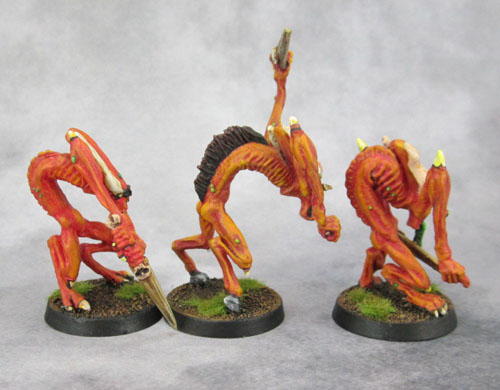
Oldhammer 1988 Realm of Chaos Bloodletters of Khorne

Bloodletters of Khorne in a Conga line.

The middle guy looks a bit odd in the front-on photo, but the profile shot helps him to make more sense. These early figures might not have been the greatest of sculpts, but they had a twisted physiology that made them work really well as Daemons. I’m glad that GW has returned to a design close to the original with the recent plastics after their iterations as cosplaying budybuilders and spiky beastmen in the interim.
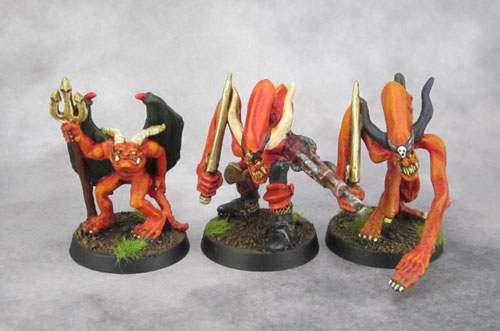
Oldhammer 1988 Realm of Chaos Bloodletters of Khorne, C18 Night Horror Demon

C18 Night Horror, Bloodletter Conversion, Original Bloodletter.

I never had many of the original Bloodletters, and still don’t. Getting them up to an even 8 (or 10, or 12) is “on the list” but they’re not cheap or easily found on eBay. Back in the day, a C18 Night Horror Demon (I guess he could be a gargoyle, but the trident is telling) got roped into the gang and has been a part of the small unit ever since. I somehow ended up with a broken Bloodletter torso, and so ended up grafting it to a spare pair of Chaos Warrior legs I had lying around after an uninspired Bear Centaur conversion. The arm is off an early Jugger rider.

Oldhammer Realm of Chaos Bloodletters, Flesh Hounds of Khorne

A small warband of Khorne Daemons.

At some point these guys will hit the table again. I’ll use Abyssal rules for KoW, though it’s doubtful that I’ll run a full daemonic army, and instead ally them with “The Herd” (Beastmen) and whatever Non De Plume that Warriors of Chaos end up with. They might be willing to ally with Nurgle, but not with the hated Slannesh or the duplicitous Magicians of Nurgle. I’m sure they’ll also end up on a 40k table, after I get some more forces up to scratch and work out which version or combination of the rules my group will play with.

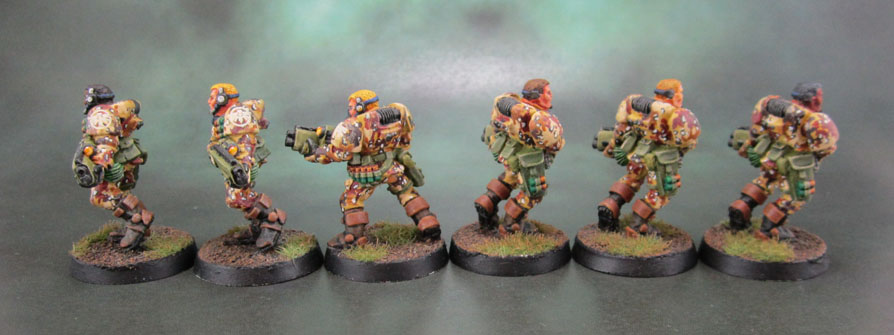
Dark Angels Space Marine Scouts – 1998 Metals

These figures are part of the fourth wave of Space Marine Scouts, released in 1998. The first were the initial two models, followed a year or two later by the second wave – an expanded range in the same style. With Advanced Space Crusade came the Scouts who dressed like a weird combination of Landsknechts and the previous designs (with clown colours to top things off). Then these guys were released, with the first Space Wolf Wolf Scouts being released shortly before, and acting in many ways as the prototype/sketch book pages for these.

If you browse the Stuff of Legends page for these figures, you’ll notice that no actual bolter-armed model exists in the line. This is why I’ve got a squad armed with shotguns. With no bolter-armed models available, these guys could be (and were) alternately armed with Bolters or Shotguns, as appropriate to the game being played. The “Sergeant” model came later. I think he was released alongside the bolter-armed model a few years later from the initial models. I believe I acquired him later on, but painted the whole gang at once anyway.

Metal Dark Angel Space Marine Scouts with Shotguns

Dark Angels Scouts – Kicking it 1998 style.

Eagle-eyed viewers might notice that these guys aren’t actually painted much like the typical Space Marine or Dark Angels Scouts. Space Marine Scouts’ of whichever chapter tend to have their armoured bits painted like their Chapter’s armour, and the soft “cloth” bits painted in a beige/off-white. All the better to scout with, obviously.

Dark Angel Scouts – Traditional Scheme

Ultramarine Scouts – Traditional Scheme

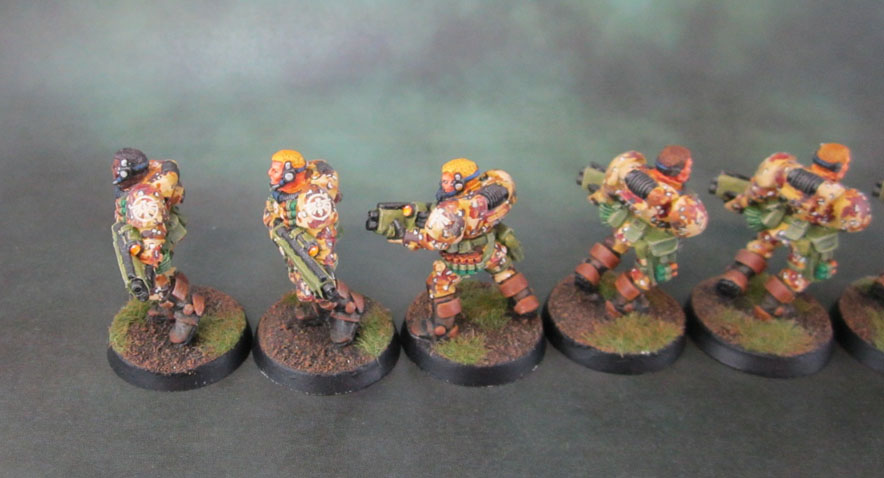
I made two choices about scouts and my 40k armies, long long ago. One is that Scouts should be dressed to scout. While it’s fine for the fully-armoured Marine brothers to charge forward in their bright, heraldic powered armour, I thought the guys with the job of doing actual reconnaissance, ambushes, infiltration, and general sneaking around should be dressed a bit more appropriately. I chose the 1991 Desert Storm 6-colour “choc chip” camouflage pattern for the Dark Angels because it was fun to paint, still pretty much in common memory, and because I didn’t want to paint them in a predominantly green camouflage. With this in mind (and reference pictures from Iraq in my folder), I painted both the “hard” armour and fatigue clothing in the camo pattern and their webbing and pouches with a nice “webbing” green. Boots were brown/black, and the weapons were given a dull green (plastic/plasteel/etc) for the furniture.

Metal Dark Angel Space Marine Scouts with Shotguns

Dark Angels Scouts – Rear and Side Views.

I used white Dark Angels transfers for the shoulders as low-visibility army identification. The white doesn’t particularly stand out on their camouflaged armour, just like real armies. The Sergeant has a slightly different transfer to make him stand out to me and other players (aside from the model’s pose), but not so much as is usual for Marine NCOs.

Metal Dark Angel Space Marine Scouts with Shotguns

Dark Angels Scouts – Army Identification

The other painting variation from the traditional theme? Several of the scouts aren’t painted with Caucasian skin tones. It comes up from time to time when people question why pretty much all Warhammer/40k models are painted as though they come from Coventry, and without getting into a whole discussion on the origins of GW, Warammer and 40k, it always bothered me a bit that there was never any growth or movement in that aspect (and still isn’t). It’s nothing to do with Political Correctness and everything to do with realism in modern armies – particularly in large armies and forces that recruit from entire worlds or a wide variety of locales.