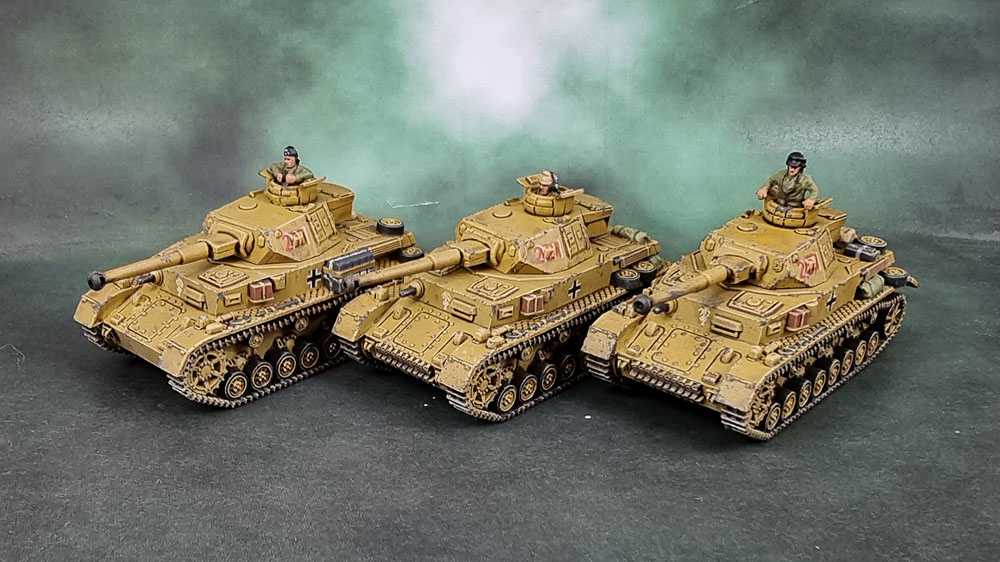
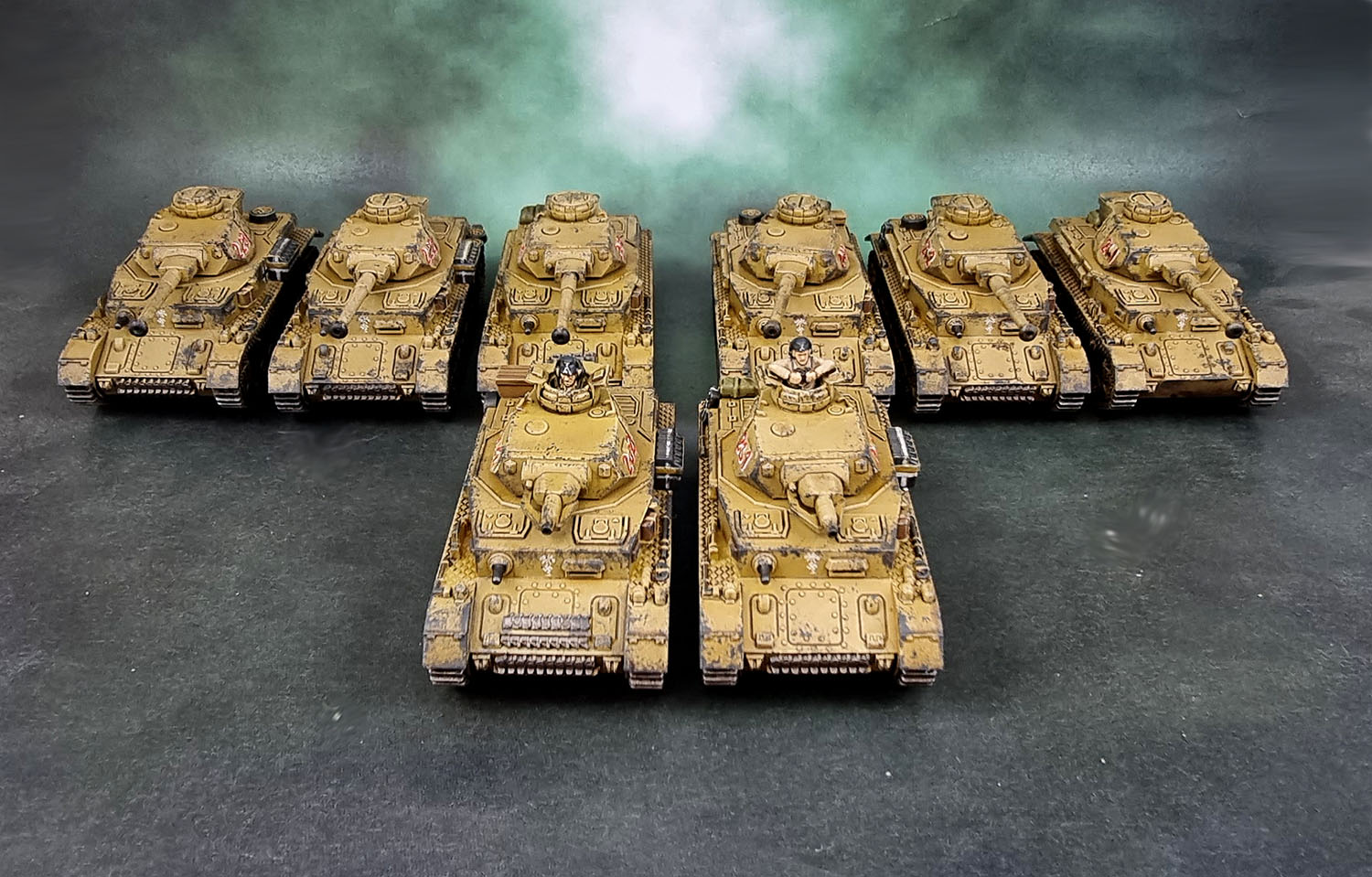
Painting Tutorial – 15mm German Afrika Korps Armour (No Airbrush needed!)

As I went through the process of painting my Afrika Korps armour, I got asked a few times in various places how I did it, and also about the possibility of putting together a painting tutorial to share my methods, so after a bit of a delay, here it is.

This method works well for pretty much any vehicle. I haven’t started on my softskins yet, but the simple step-by-step method outlined here should get you through most of those as well without much trouble. I haven’t tried this on larger scale models yet, but I have some Bolt Action 28mm/1:56 German Panzers I intend to paint with the exact same methods, and I don’t foresee any issues using the same techniques.

Enough preamble! Get to the monkey!

Obviously, you clean and assemble the model before we get started. You can figure out that part on your own, or perhaps with the supplied instructions or webpages as appropriate.

STEP 1: Start with a Spray Prime. I don’t use black or white over the bare plastic/metal/resin kit – I just go straight for US Khaki (Vallejo)
You should spray the turret and hull as seperate pieces, and I do the undersides of both as well, but you do you on that.
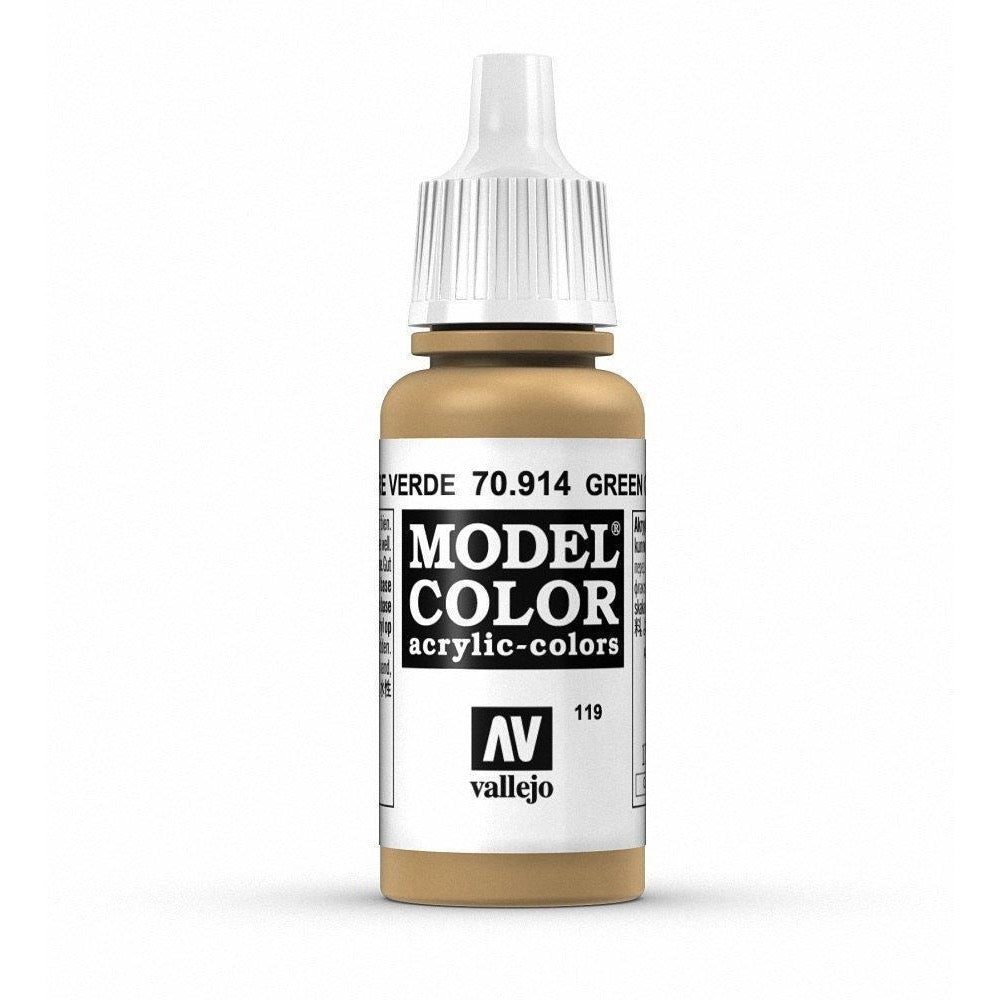
STEP 2: Spray Basecoat Desert Yellow (Vallejo). I do this as a Zenithal coat from the top and top angles of the model. It’s also worth noting that Vallejo’s Spray Can Desert Yellow is actually the equivalent to Vallejo Model Colour Green Ochre 74.914 and NOT Vallejo Model Colour Desert Yellow 70.977. This is because…. reasons.
You should again spray the turret and hull as seperate pieces, though we’re not doing the undersides of the model this time. We’re leaving that US Khaki there.
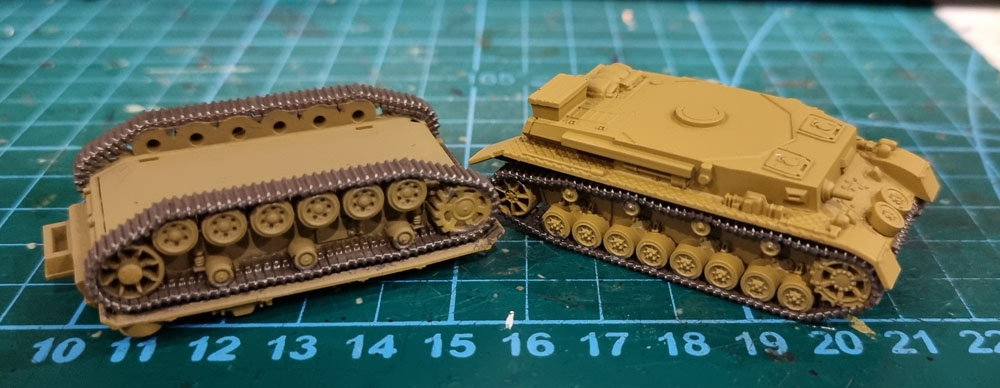
STEP 3: Paint Tracks with Vallejo Panzer Aces Track Primer (304). Try to be reasonably neat, but mistakes can of course be fixed up with that Green Ochre mentioned above.
STEP 4: Drybrush tracks with Citadel Leadbelcher.
For this step, you could also choose to drybrush with a mid-dark grey (Panzer grey) and then more lightly drybrush the metallic over the top of that. Either works, especially at this scale, though I’d probably use the grey as a mid-point if painting a 28mm/1:56 scale model for say, Bolt Action.
Once again, try to be neat here just to save you some work afterwards.
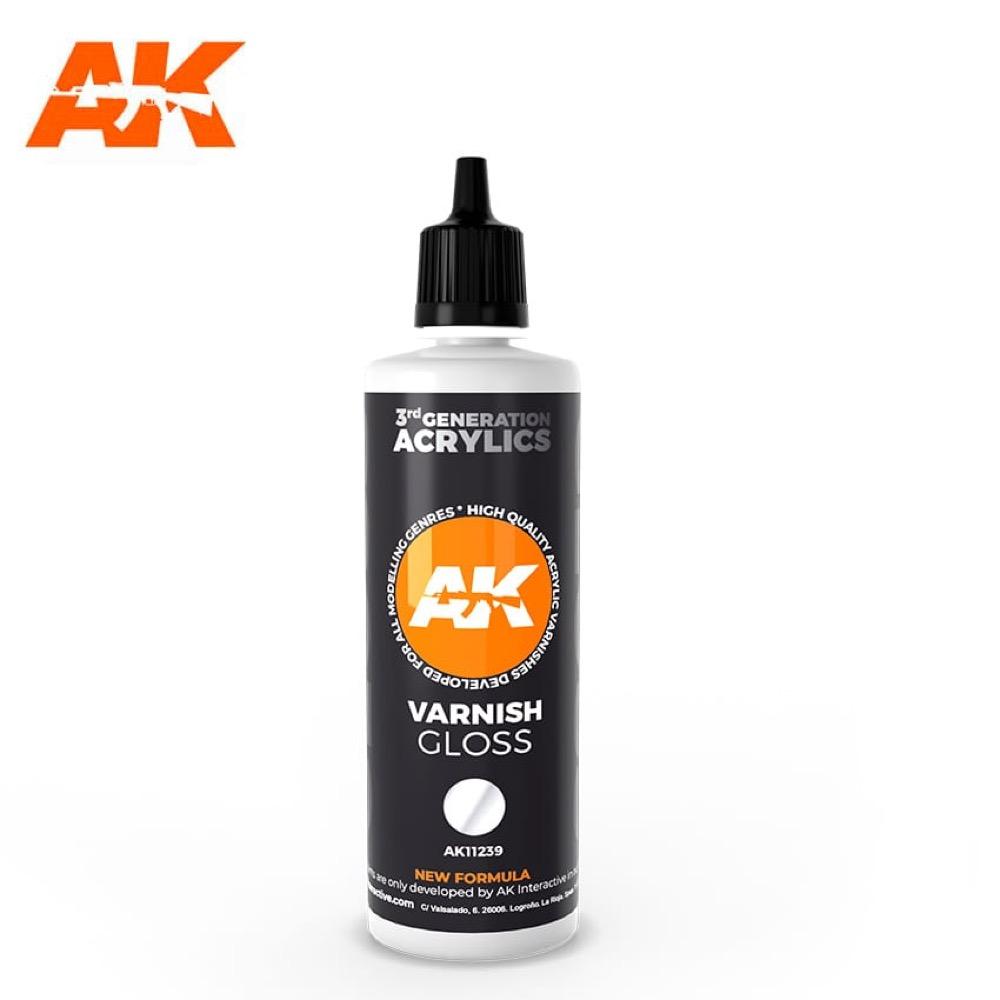
STEP 5: Brush on AK Interactive Gloss Varnish (AK11239) where you’ll add decals to create a good surface to apply the decals. Let the varnish dry fully.
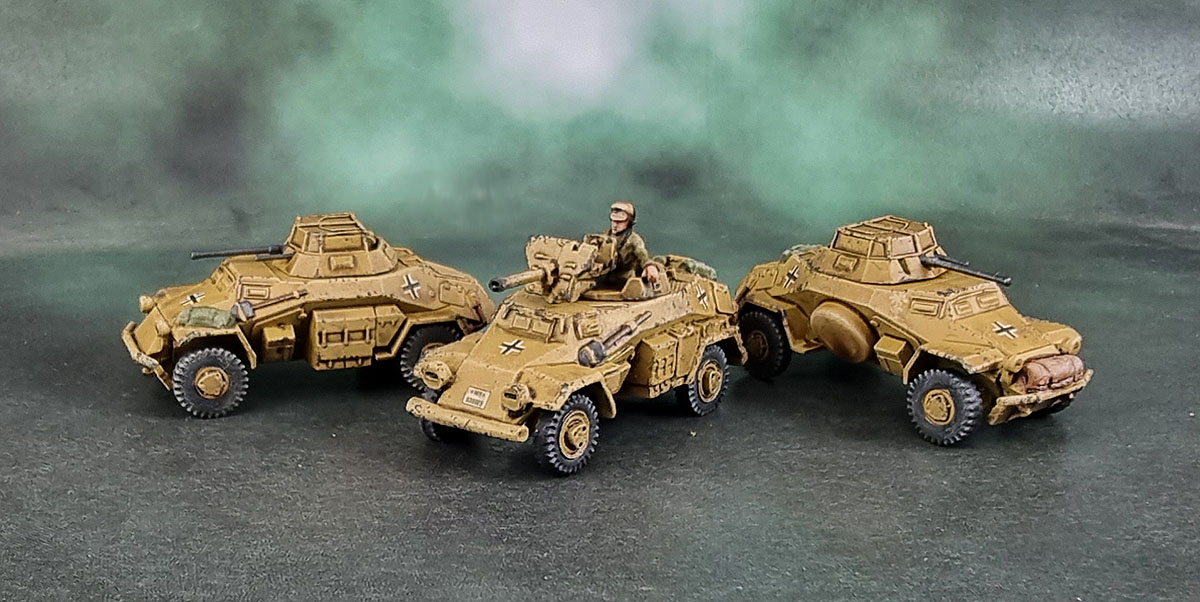
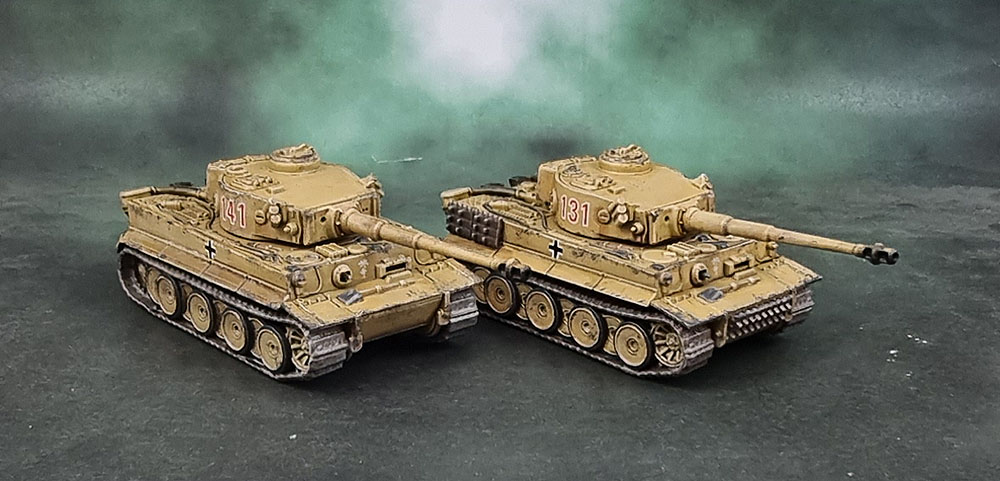
Where to add decals? It depends on the vehicle type/unit/etc. There are lots of sources that can show you proper placement for the markings on Tigers, Panzer IIIs, Panzer IVs, 222’s and so on.
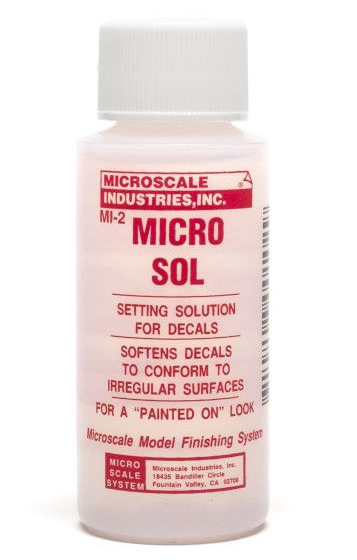
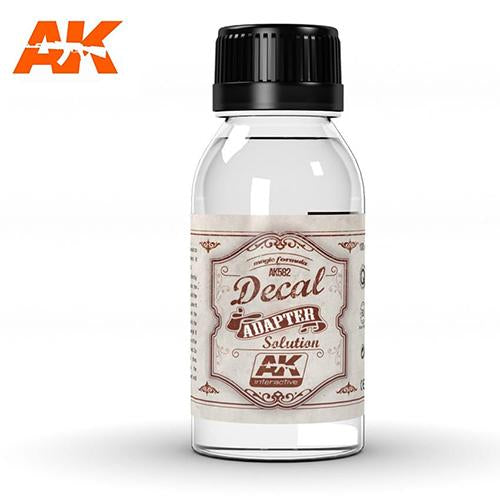
STEP 6: Add decals where appropriate. I highly recommend using Using Micro Sol to apply and Micro Set or other equivalent products like AK Interactive Decal Adapter (AK582), Mr Mark Softer, etc. to fix them over the vision ports. Once again, Let the decals set fully.
I’ve now fully moved to using the AK product for the softening step over Micro Set for the softening step, but still recommend Micro Sol for the application (and for when you don’t need to soften a decal to fit over uneven surfaces.)
STEP 7: Apply another coat of AK Interactive Gloss Varnish (AK11239) by brush over decals to seal them in. Again, let the varnish dry fully.
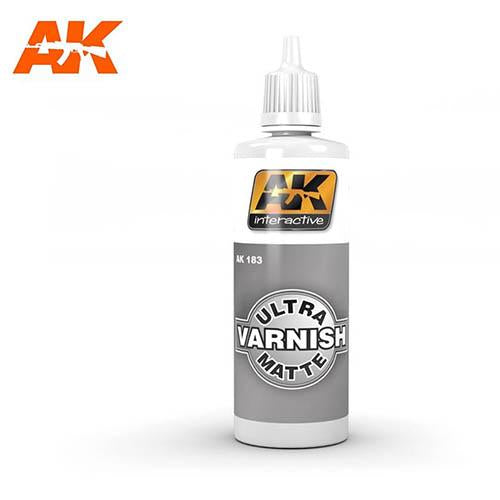
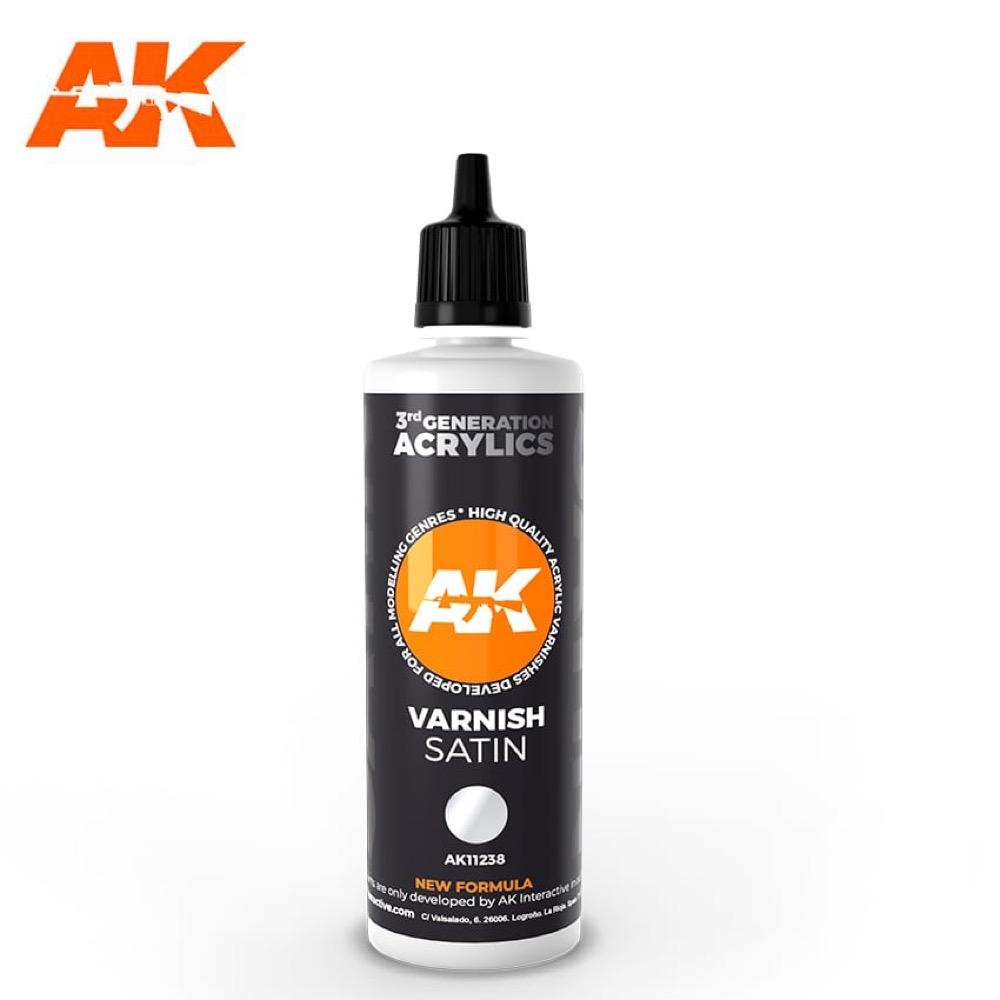
STEP 8: 50-50 mix of AK Interactive Ultra Matte Varnish (AK 183) and AK Interactive Satin Varnish (AK11238) over the glossy area where the decals are located, including the decals. I use the mix to achieve the same finish that the paints have at this stage, so the next steps of washing will be consistent over the entire model.
IMPORTANT ASIDE: I haven’t taken photos of each decal application step because it’s simply adding decals and varnish. The layers of varnish stop the “frosted” look that the the transparent film on decals can sometimes have – this frosted look is caused by applying the smooth decal to the rough surface of the model. Adding the gloss varnish before adding the decal creates a smooth base to lay the smooth decal on, and the gloss over the top “seals” the decal in, so the result is that the decal should look like a part of the model. The models look pretty much the same throughout these steps, though – there are lots of good YouTube videos on applying decals.
STEP 9: Wash everything with Citadel Agrax Earthshade Gloss.
For best results, I find that It’s best to do the turrets separately, and even do each side of the tracks separately.
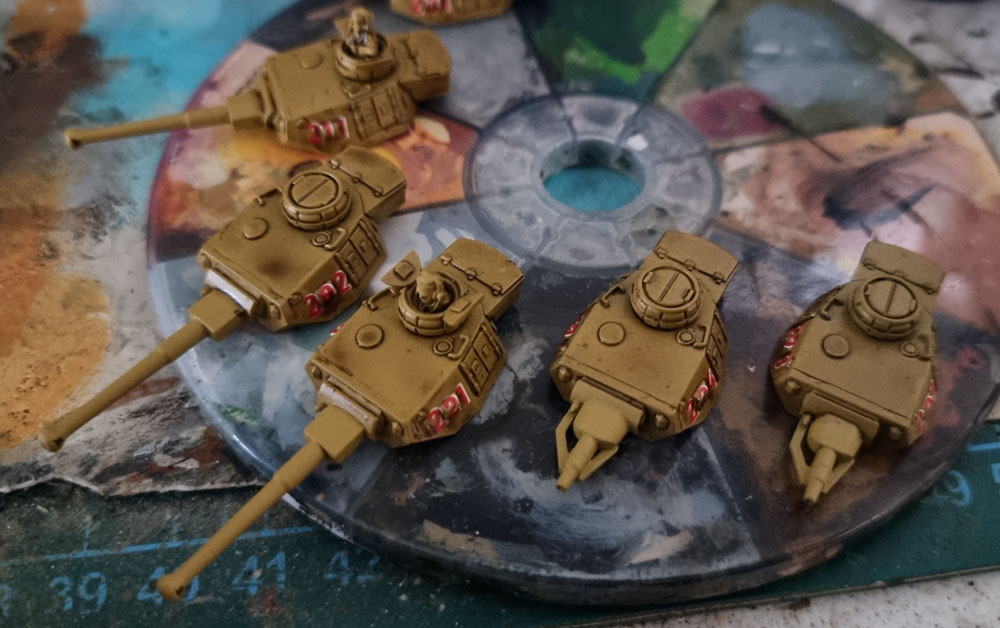
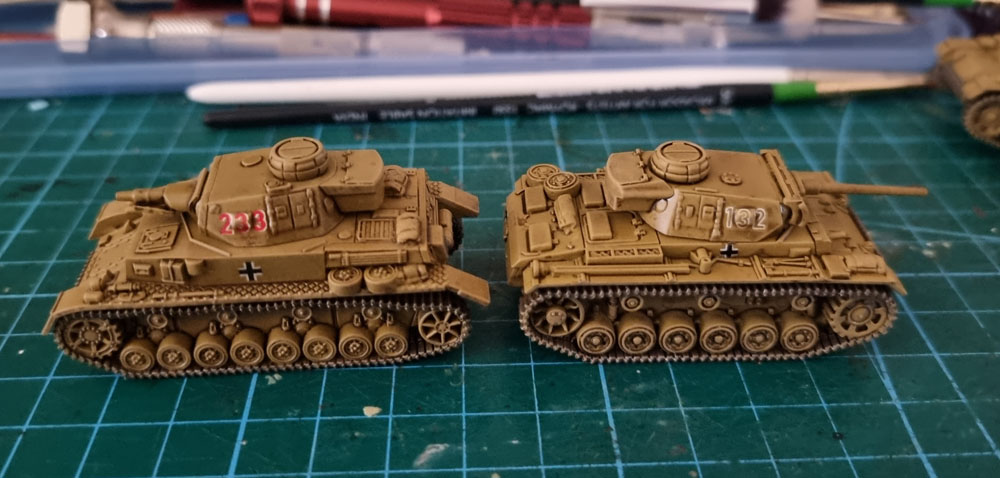
This pic shows one side of models after washing en masse,. Make sure you let the Agrax Earthshade Gloss dry for a good amount of time, then flip them and do the same again before finally placing them upright on their tracks and washing the rest of the hull.
At any point from here you can call the model(s) done, if you really like. They’re perfectly playable at this stage, but continuing really does reap aesthetic rewards.
STEP 10: Drybrush #1 – the “Desert Yellow” parts of the tank with Vallejo Model Colour Green Ochre (70.914) – you want this to be a decent drybrush, but you don’t want to go too heavy and cover up the effects of the wash. You’re just reestablishing the base colour.
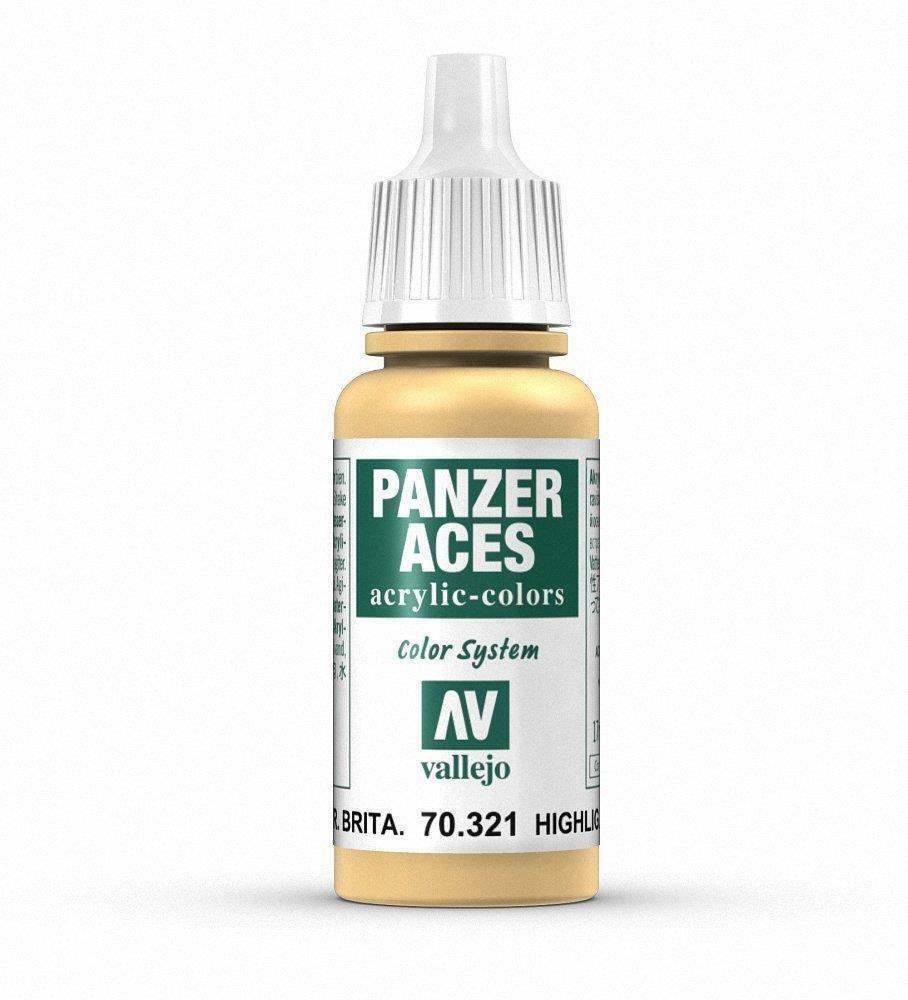
STEP 11: Drybrush #2 – 50-50 mix of Vallejo Model Colour Green Ochre (70.914) and Vallejo Panzer Aces Highlight British Tanker Crew (321).
This is a lighter drybrush, more concentrated on the edges and upper areas of the vehicle. It really makes the edges pop nicely as you can see.
STEP 12: Paint the road wheel rims/rubber with Vallejo Surface Primer German Panzer Grey (73.603) This is the most painful part of the entire procedure – it’s all uphill from here. …or is it downhill? Uphill, I think
Paint hull and turret machineguns with Vallejo Surface Primer German Panzer Grey (73.603) as well since you have it out. Cleanup / neatening up as needed using Vallejo Model Colour Green Ochre (70.914).
STEP 13: Now is when you paint the bits and pieces. Stowage boxes (whatever browns you like), tarps and bedrolls (whatever military greens through browns you like – I tend to use the same pale sand colours and browns listed below for modulation and rain streaks),
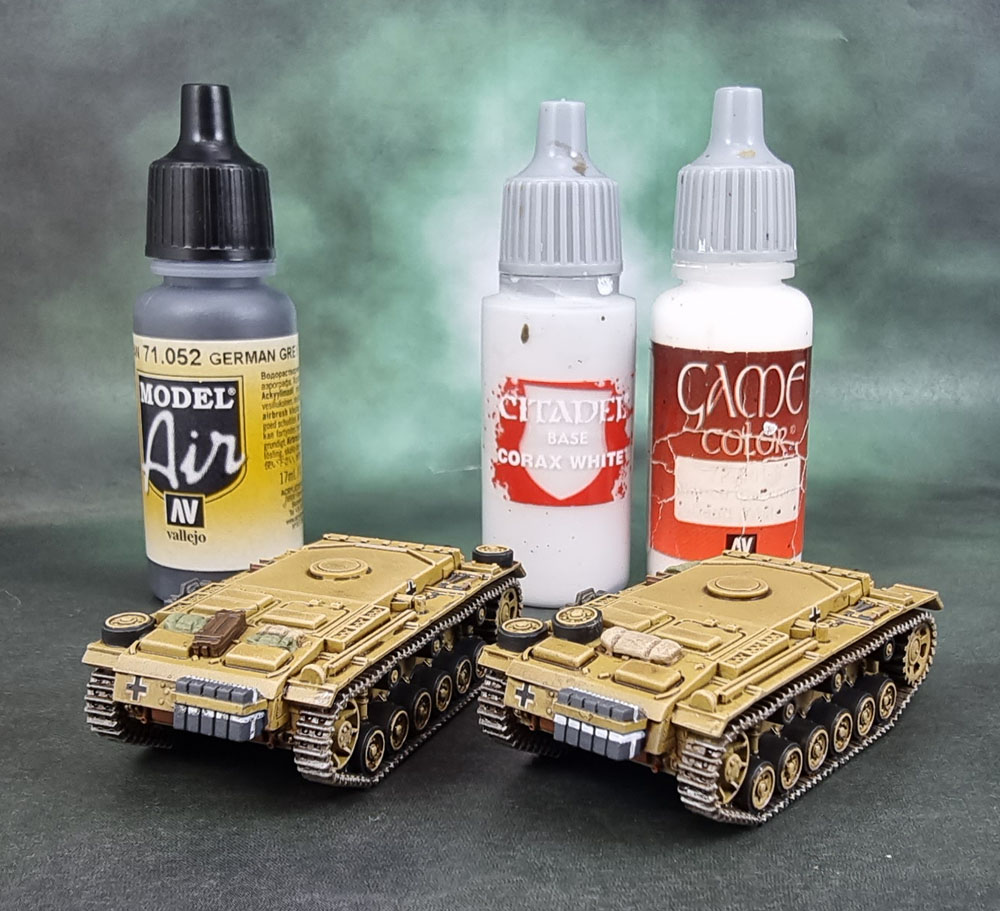
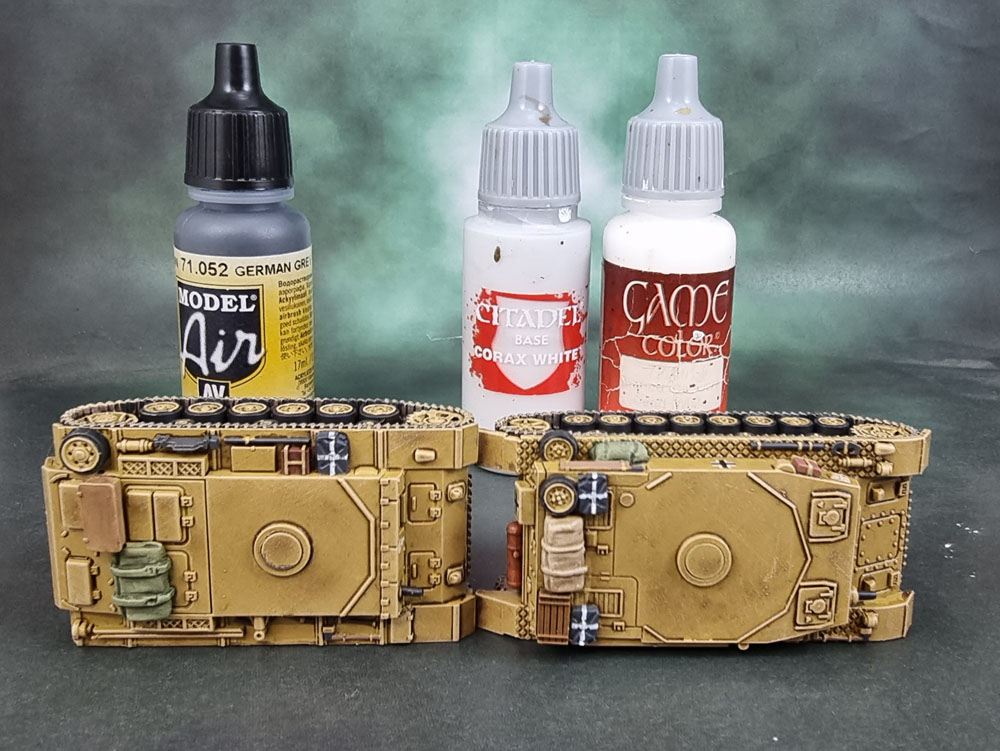
Jerry cans – I like using Vallejo Model Air German Grey (71.052), with thin Citadel Corax White for the crosses on Jerrycans – with little picked out bits of Vallejo Game Colour Dead White (72.001) (or whichever brand you like) for highlights. For those little integral boxes caged on the sides of Panzers I use Vallejo Model Colour Saddle Brown (70.940),
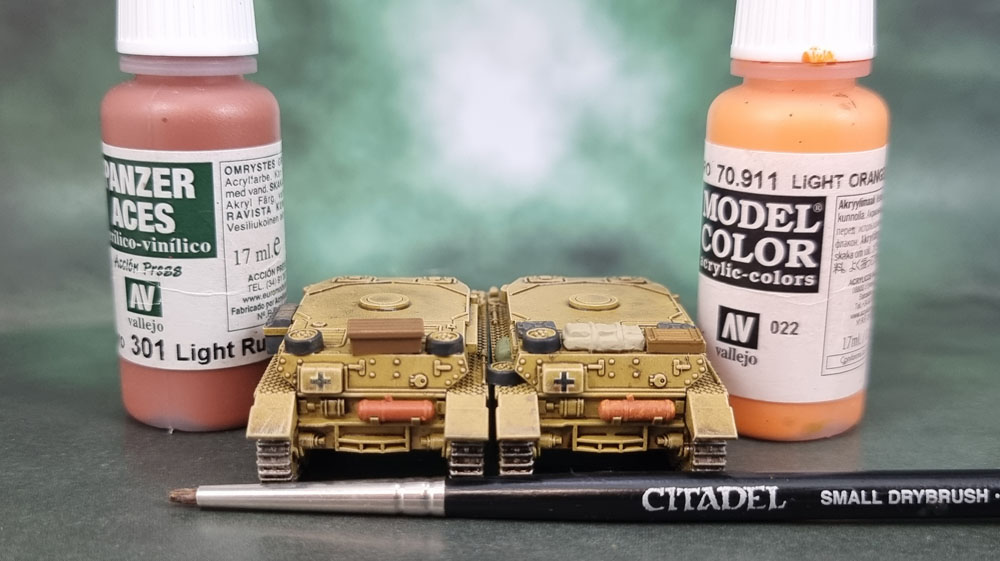
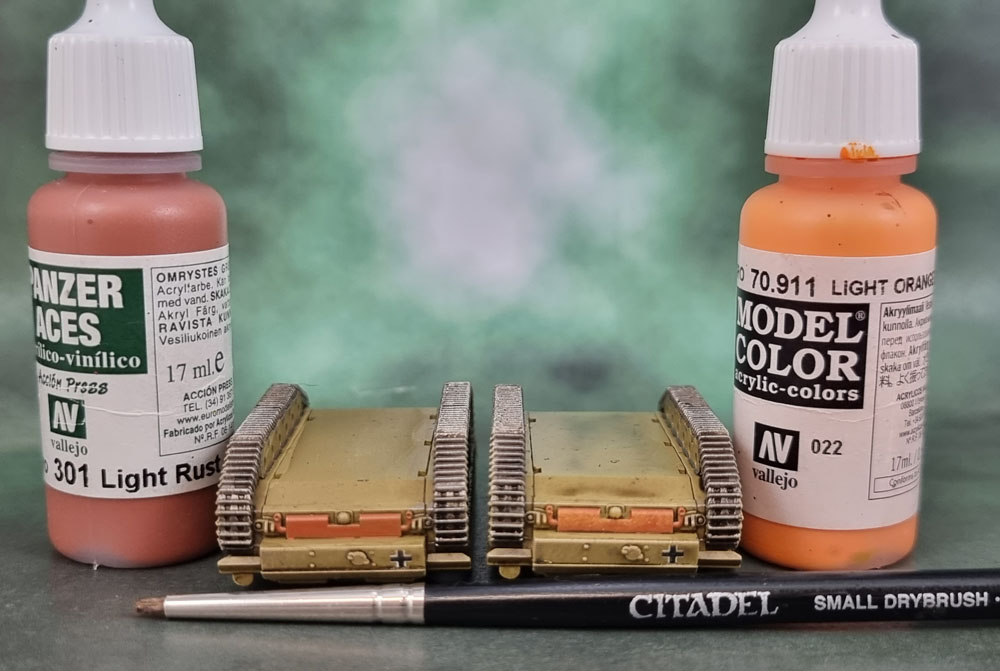
For the exhausts Vallejo Panzer Aces Light Rust (301), then carefully and lightly stippled with Vallejo Model Colour Light Orange (70.911). We’ll wash that with Agrax Earthshade Gloss to bring out the details and darken it a little. You may even choose to give it a followup coat of regular Agrax Earthshade or Army Painter Strong Tone if you prefer darker exhausts.
STEP 13: Spot wash all the rest of that crap with brown and/or green washes. (I’ve got the paints for the Jerrycans in the pic above!)
I use Army Painter Quickshade Military Shader for greener tarps and Army Painter Quickshade Strong Tone (Citadel Agrax Earthshade is just as good) for boxes and brown tarps. Agrax Earthshade Gloss over the exhausts as noted earlier.
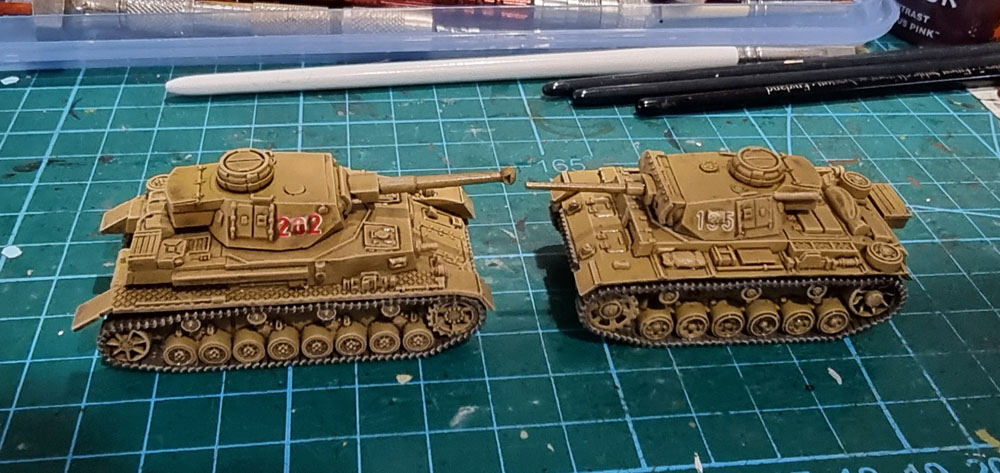
I forgot to take a photo of Step 14. I’m so embarassed, since the tanks look bloody nice here. Even I was tempted to stop the first time.
STEP 14: Drybrush #3 – 80-20 mix of Vallejo Model Colour Green Ochre (70.914) and Vallejo Panzer Aces Highlight British Tanker Crew (321) (a really light drybrush this time)
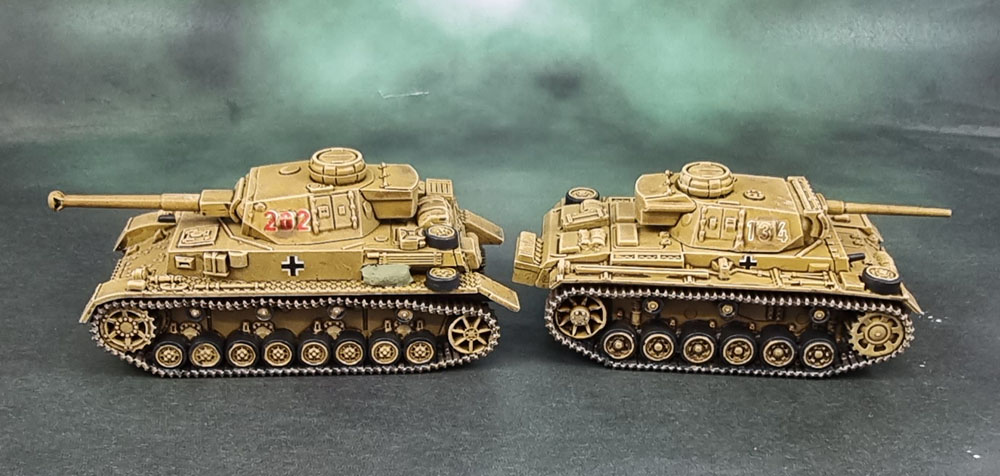
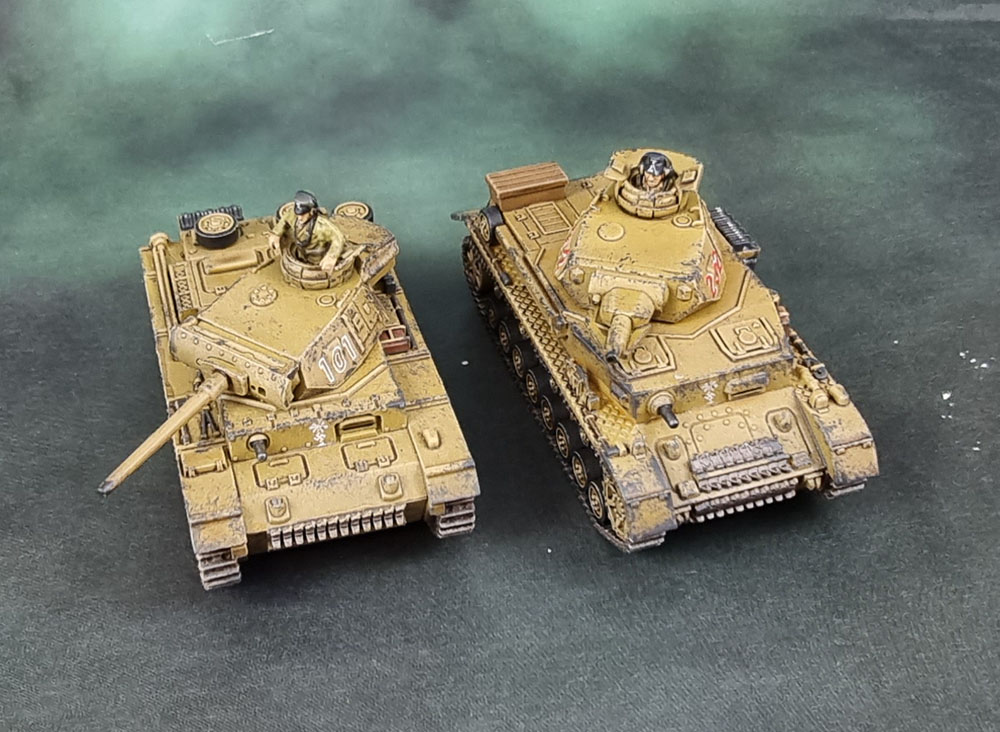
Now they’re “finished” if you want nice, “clean” models that have a similar overall look to the Games Workshop type of finished vehicle.
Optional step 1: Colour Modulation I – Thin down Vallejo Model Colour Green Ochre (70.914) with Citadel Lahmian Medium/Water/your medium of choice – add some colour tone and variation back into the larger panels to taste.
Optional step 2: Colour Modulation II – Thin down Vallejo Panzer Aces Track Primer (304) and/or Vallejo Game Colour Leather Brown (72.040)/Citadel XV-88 with Lahmian Medium/Water/your medium of choice – add some colour tone and variation back into the larger panels to taste. Be sparing, but this is where you add some additional tonal variation – as little or as much as you feel they need.
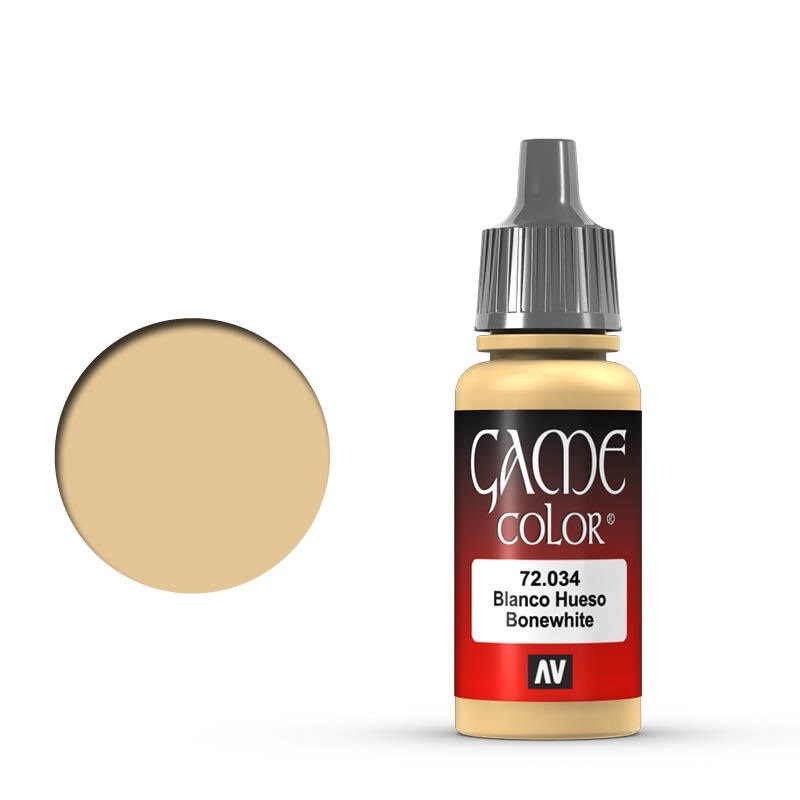
Optional step 3: Rain Streaks – Thin down some sand coloured paint – your choice but I like anything from Citadel Ushabti Bone/Vallejo Game Colour Bonewhite (72.034), Vallejo Model Colour Iraqui Sand (70.819) and thin them down with Lahmian Medium/Water/your medium of choice. Then with a very fine brush, add some vertical streaking to represent rain streak marks. I find less is more, so don’t overdo it.
I almost always do the two colour modulation steps, but they’re kind of hard to photograph in a meaningful way.

Tank hulls after the first layer of stippling.

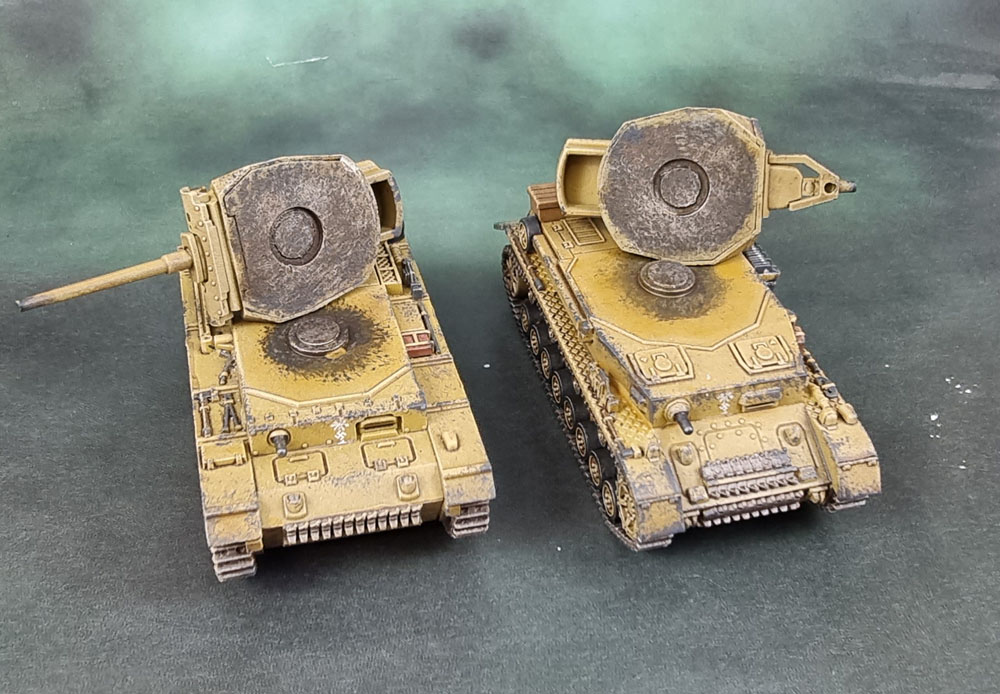
Advanced Step 1: Turret Damage. This is something that probably hasn’t been seen on the blog, since it’s not visible when I post my usual images of finished tanks and vehicles, but it’s an extra step I’ve done on every tank and AFV that has a removable turret. It’s much more for gameplay aesthetics than display models, since it will be hidden much of the time.
It’s basically just a number of layers of progressive stippling. You can see the colours I use from left to right, and how they look at each stage. I use a cheap, medium-small makeup brush from Amazon (about 6mm diameter). In order, the paints above are:
Vallejo Surface Primer German Panzer Grey. (I get the 200ml bottles and decant it into the dropper bottle for everyday use with a brush), Vallejo Model Air Metal Black (71.073), Vallejo Game Colour Tinny Tin (72.060), Citadel Leadbelcher, and then after the final stipple step, I wash them with a 1:1 or 50/50 mix of Vallejo Game Colour Smokey Ink (72.068) and Citadel Lahmian Medium.

Tanks be fine.

Tanks go boom!

Advanced Step 2: For me, this is the big one.
Chipping – I found that a “proper” panzer grey looks too black against the sand colour that the armour is painted in, so I used Vallejo Model Colour Dark Grey (70.994). Put a little on your palette, use a small bit of torn foam on the end of a pair of tweezers and dab it into the paint. Dab most of it off onto the paper/a tissue etc and then carefully touch it to the edges and panels of the tank to taste – again, be careful to not overdo it – it’s easy to go back later and add more, but a bitch to try and remove it!
Here’s a quick, quality tutorial from Secret Weapon Miniatures.
Advanced Step 2: Drybrush the ends of gun barrels with Vallejo Panzergrau Coloured Surface Primer (73.603)
Sealing: Spray with AK Interactive Matt Varnish Spray (AK1013) – again, do the turret and hull separately. It gives a nice, flat (but not too boringly flat) finish.
DONE!
Materials I use.
These are the paints and materials that I use for my Afrika Korps vehicles. You can of course use whatever you like, and paints that are close enough to the ones listed here should net you a close enough outcome.

Sprays:

US Khaki (Vallejo)
Desert Yellow (Vallejo)

AK Interactive Matt Varnish Spray (AK1013)

Brush-Applied Paints:

Vallejo Model Colour Green Ochre (74.914)
Vallejo Model Colour Saddle Brown (70.940)
Vallejo Model Colour Light Orange (70.911)
Vallejo Model Colour Iraqui Sand (70.819)
Vallejo Model Colour Dark Grey (70.994)

Vallejo Panzer Aces Track Primer (304)
Vallejo Panzer Aces Highlight British Tanker Crew (321)
Vallejo Panzer Aces Light Rust (301)

Vallejo Model Air German Grey (71.052)
Vallejo Model Air Metal Black (71.073)

Vallejo Game Colour Dead White (72.001) OR Any proper white paint that works nicely – Citadel White Scar is generally trash.
Vallejo Game Colour Leather Brown (72.040) OR Citadel XV-88
Vallejo Game Colour Bonewhite (72.034) OR Citadel Ushabti Bone
Vallejo Game Colour Tinny Tin (72.060)

Vallejo Surface Primer German Panzer Grey (73.603)

Citadel Leadbelcher
Citadel Corax White

A couple of whichever military greens through browns through tans you like for wooden boxes, bags and rolled tarps. Pick some from above.

Brush-Applied Mediums/Washes:

Citadel Lahmian Medium
Citadel Agrax Earthshade Gloss

Army Painter Quickshade Military Shader
Army Painter Quickshade Strong Tone OR Citadel Agrax Earthshade

Vallejo Game Colour Smokey Ink (72.068)

Brush-Applied Varnishes and Decal Solutions:

AK Interactive Gloss Varnish (AK11239)
AK Interactive Ultra Matte Varnish (AK 183)
AK Interactive Satin Varnish (AK11238)

AK Interactive Decal Adapter (AK582) (or Micro Set)

Micro Sol

Painting Skeletons – A Warm Bone Tutorial.

Like great men everywhere*, I’m always happy to share my methods and techniques when asked. In this case, Imperialrebelork asked me if I could share how I paint the bone on my skeletons and other undead, and as I had these guys coming up in the queue, they provided me with a perfect set of models to use as an example. It’s a pretty simple system. Pretty much base coat, two down and three up.

*Note – I’m not calling myself a great man, just saying that like great men, I’m happy to share. 😉 – OR AM I?

Cleaned model & Primed model.

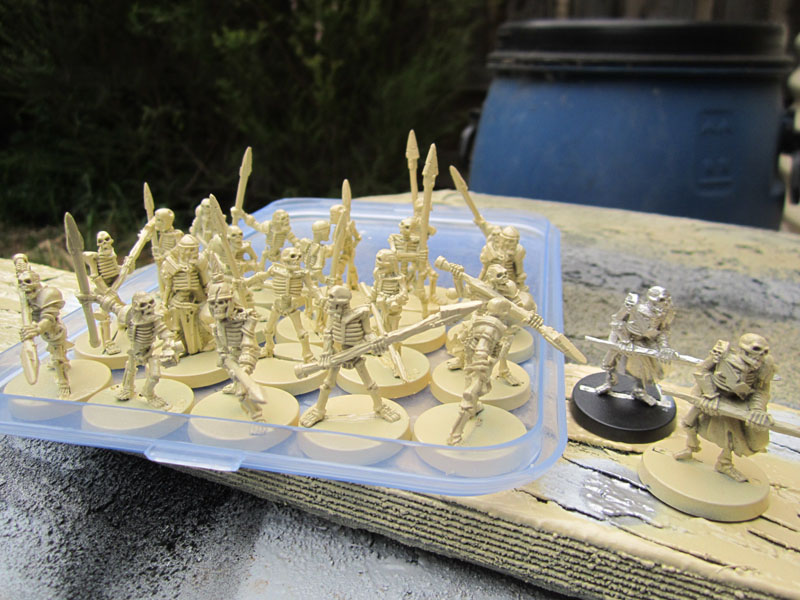
The first thing was the usual. Cleaning the models. In this case, a mob of 22 metal “fir bolg” skeletons from Brigade Models. I’d have taken a photo, but I forgot and it doesn’t really matter. Unpainted bare metal models glued down to plastic slottabases. Not a huge stretch of the imagination, amirite?

Now usually, I prime skeletons white. I know a lot of people prefer to start dark, but I’m the opposite with skellys. In this case, I did something a little different to my normal way. I recently asked Marouda to grab me some spray paints when she went past a local hardware place. I’ve been using Several Shades of Grey on some scenery projects that I haven’t yet shown, and also asked her to pick this one up for me, as a trial for undead.

White Knights Squirts – Gloss Cream – AU$7.45 from Bunnings.

We all know that GW cycles through a bunch of different coloured sprays for basecoats every few years before losing interest and discontinuing them, and Army Painter cans are popular. Both cost around AU$30 on average last time I cared enough to look. This can was less than ten bucks. I’ve had mixed results with Army Painter and Rustoleum on models, but nice cheap White Knight seems to come through every time. It’s good stuff. I’d have been happier with matt, but it’s a base coat and I’m going to seal them when it’s all said and done anyway, so whatever.

After their spray with White Knight

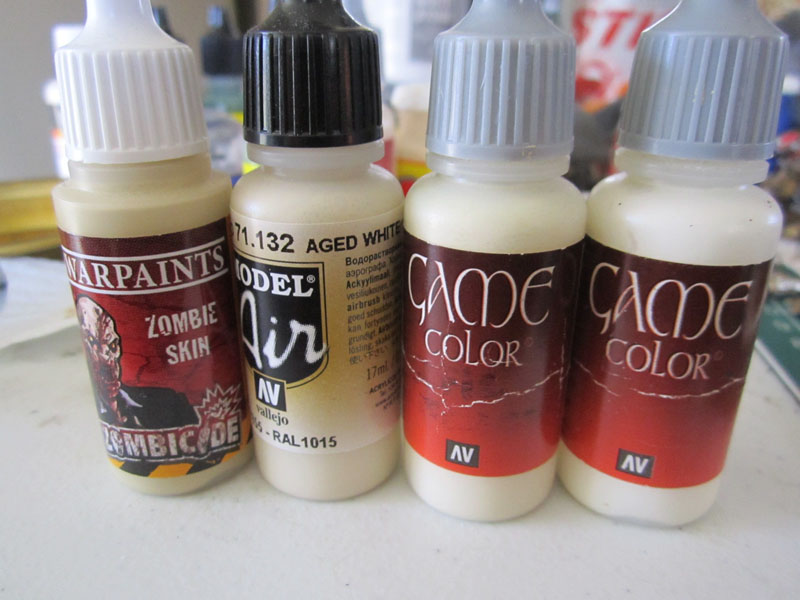
Now usually, I spray prime white, then I paint all of the bone elements of the model with Old-GW “Bleached Bone” or the equivalent. (Ushabti Bone, Vallejo Bonewhite, etc). – for something different, I gave this paint a test, and it looked just fine. No problems with coverage, etc – so I did the whole lot in it. Except for one model who fell down on my desk that I missed – Little bastard! Since it’s a spray it didn’t manage to hit every little bit, so the choice is to tidy up with Bonewhite (as I use the Vallejo) or respray depending on how much is missed.
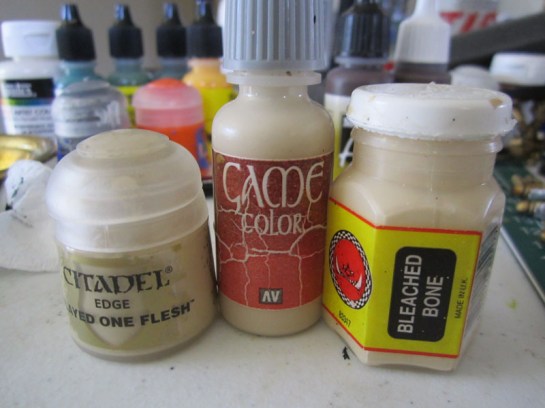
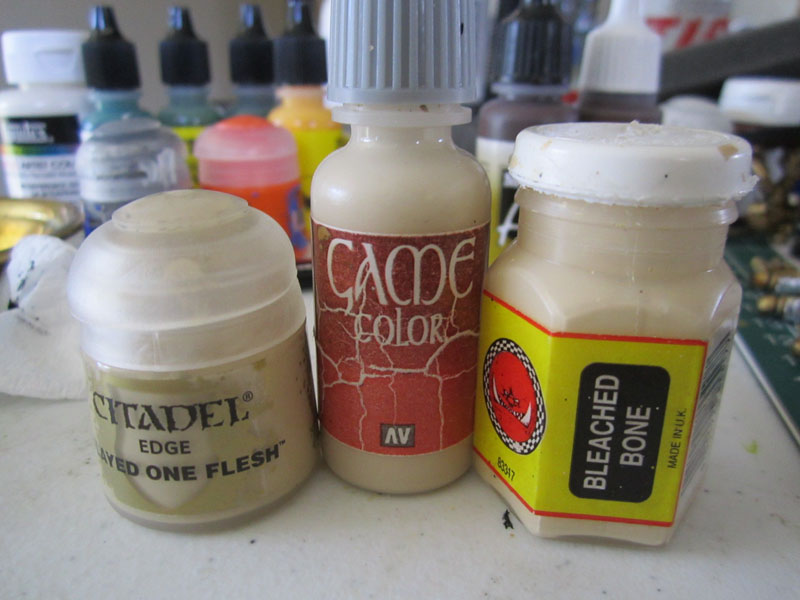
A choice of bone basecoats

Assuming that you don’t have a local source of cream/bone coloured spray paint, or just prefer not to, these are a few paints that would work just as well. I’ve never used Flayed One Flesh and am unlikely to since I’m quite happy using the last of my old-school bleached bone and the Vallejo Bonewhite – the same paint I use for touchup after the spray.

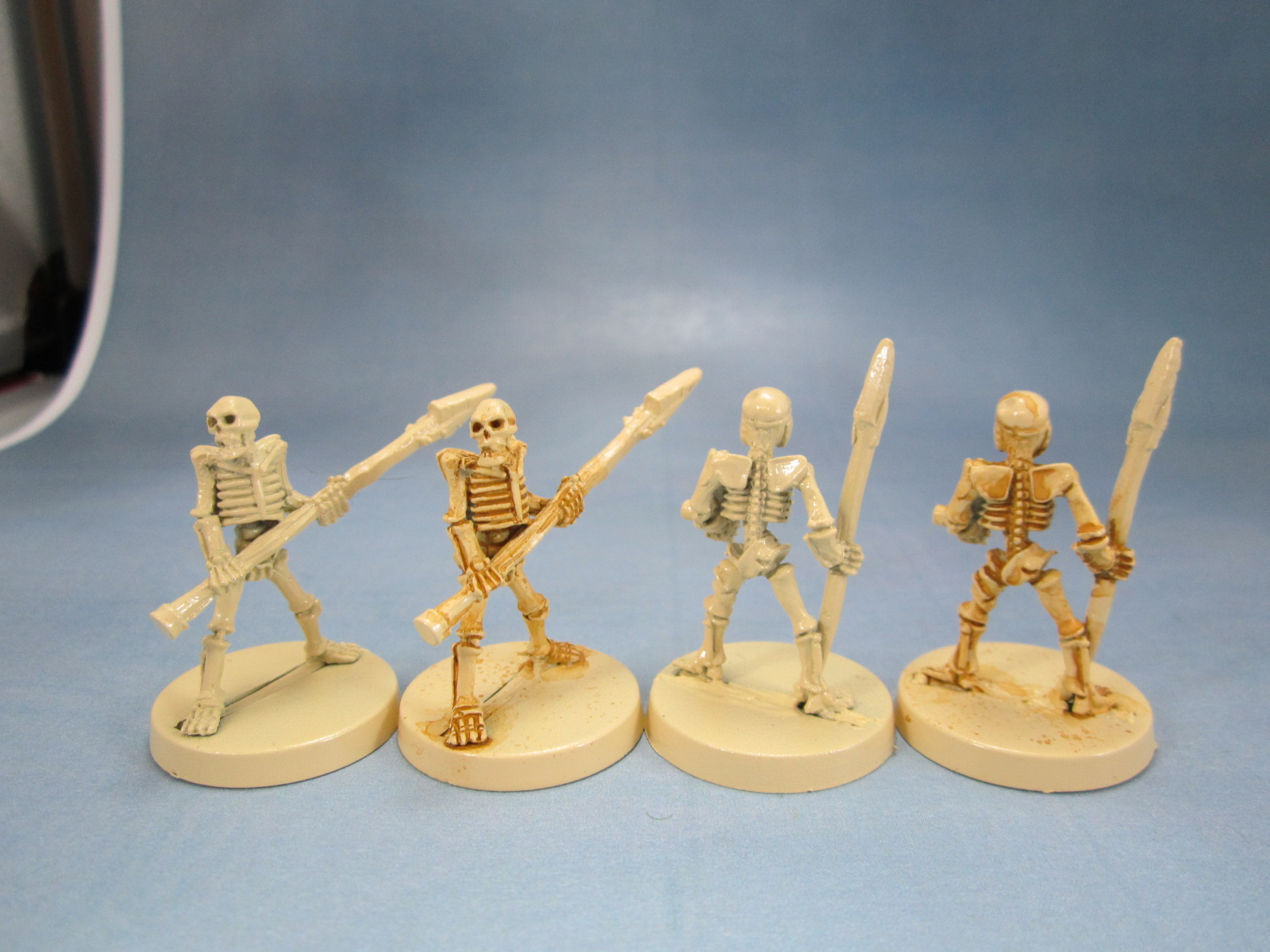
With and without the first shade layer.

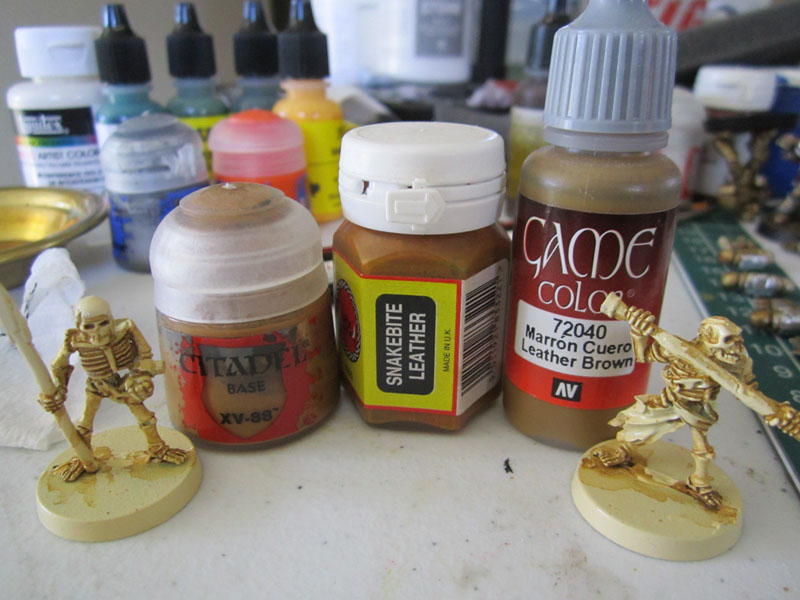
The first shade layer is applied with a very-thinned “Snakebite Leather” or equivalent. Lately I’m using XV-88, which – despite it’s ridiculous name – has a colour and consistency that I like very much. Often when painting over traditional paint I use saliva to thin the paint. I drop a little drop of clean saliva (no bubbles) into the palette and a drop of paint next to it and then draw them together. Saliva has a slightly more “elastic” quality to it than mediums be they water, Lahmian Medium, Windex or commercial acrylic medium. This allows better control with the brush when moving it around on the model. Blame John Blanche and a very old White Dwarf’s “Blanche Itsu” article.

All of these paints are effectively "Snakebite Leather" for the first shade layer.

With these models, I used windex and water. The nature of having used a gloss enamel spray can for the base coat meant a much smoother finish to the models than if I’d painted them with white primer followed by acrylic miniature paint. As you can see above, the flow was smooth, and white there are a few tide marks left in spots like the shoulder blades and near the arm joints, that’s fine – they get fixed later. You can also see that as well as going into the recesses between bones and joints, the wash also stains the bone slightly.
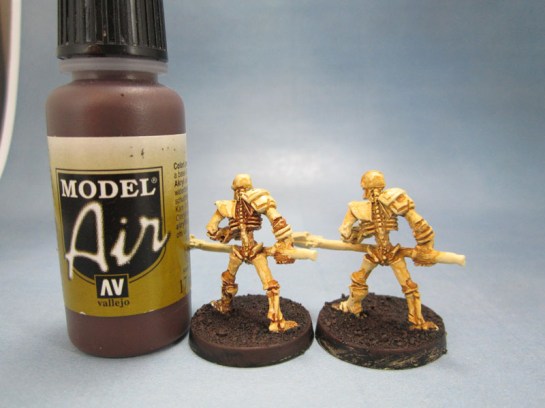
Second layer of shading – almost a lining exercise. After (left), Before (right)

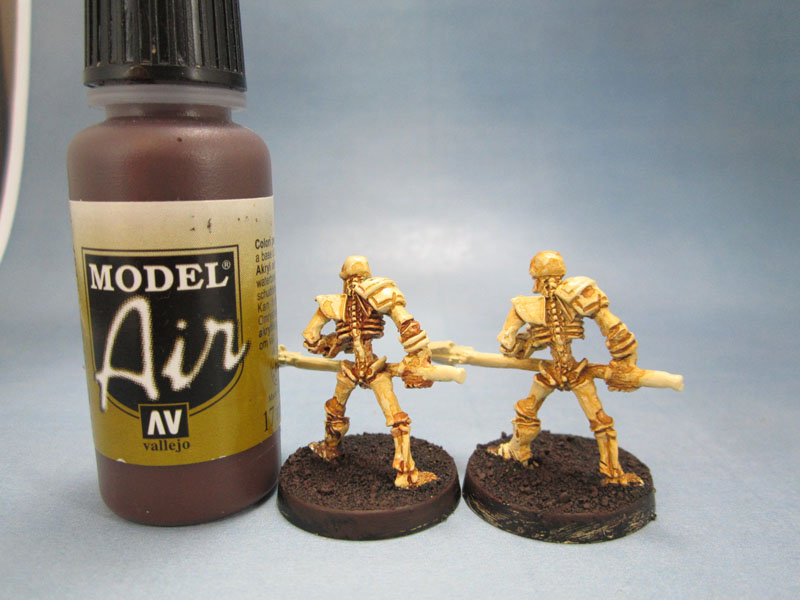
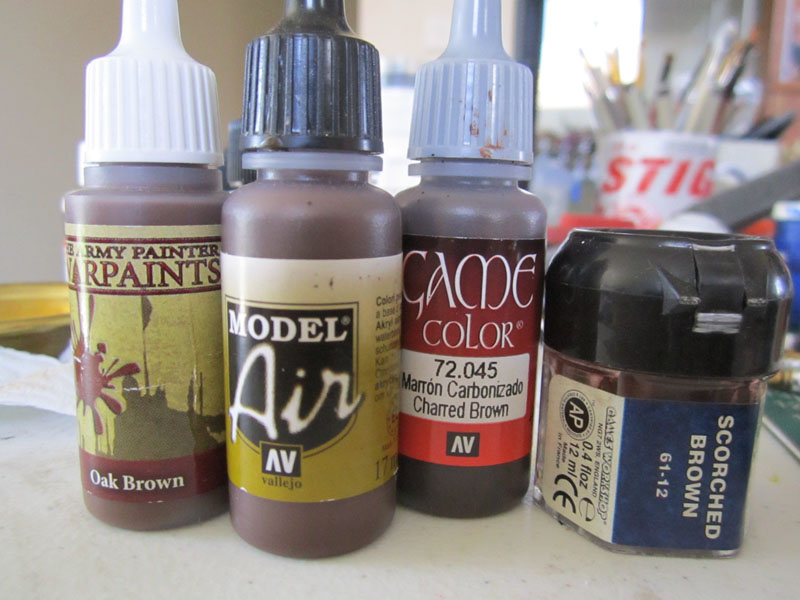
The next step is the second layer of shading. I use a very dark brown paint – and again that can change from batch of skeletons to batch. Once again I thin the paint right down via either saliva or various mediums. This second layer of shading is something I’ve only started doing in the last couple of years. Might have even been last year, but I think it adds nicely to the final result – though I guess it’s optional if you’re wanting to get them done a bit faster. This time, I shade only between specific bones. Between and underneath the ribs, and then I do major joints. So elbows, knees, hips, the jaw, sometimes between the fibula and tibia (lower leg), sometimes between the radius and ulna (forearms). I also line between the fingers and toes but not the metacarpals and metatarsals (the bits of our hands and feet usually covered in skin). Sure, it’s not especially realistic to have the fingers defined but not the metacarpals in a skeleton but it’s a visual look that works since we’re used to looking at fingers and toes.

This Model Air paint: 71.041 Tank Brown – is my current go-to. I had to write the number on the label after it wore off the main part.

The important thing here is to keep the second layer of shading to joints and holes, etc only. We don’t want to be staining the top layer if at all possible. I do go over the mouth and teeth area, as well as the nose, eye sockets and a very subtle-thin bit in the sphenoid – where your temple is behind the eye sockets/orbitals.

Any of these will work. The AP is a bit lighter though, so would be my last choice.

Now our two layers of shading are done – the “two down”. We do our three layers of highlighting – or the “three up”. The first layer is the same bone that we used for our basecoat, as seen up the page. Thin it down nicely (saliva recommended) and then carefully overpaint the bones in spots where they’re raised – leaving the lower and most recessed bones untouched. This is where we start to neaten up the tide marks and other messy bit left by our two layers of shading. The first layer of highlighting is essentially restoring the base coat colour to the model where it’s needed while neatening and leaving the shading that we want to keep.
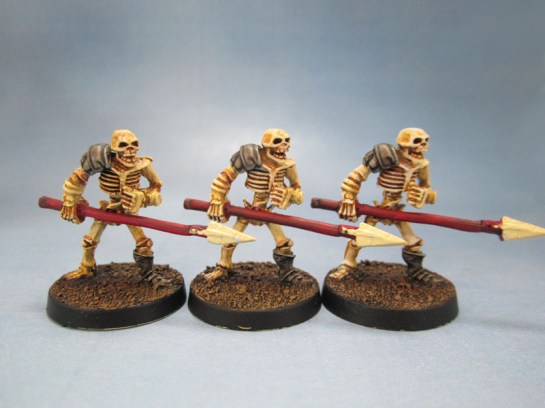
L-R: No highlight, Layer 1, Layer 2

The second layer is pretty simple as well. With a lighter shade of the same colour (or add white) we highlight more of the edges of the bones, top and sides of the skull, the parts of the ribs at the forefront of the model, the spinal column, the raised portions.
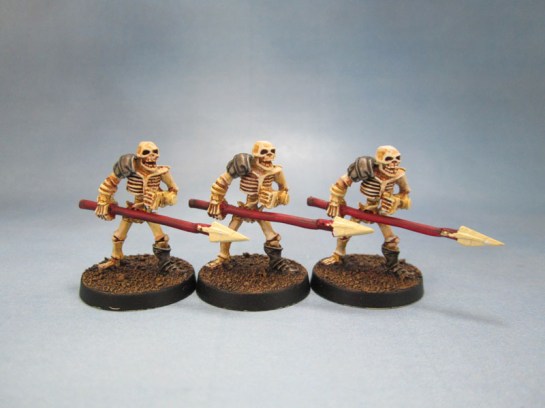
L-R: Layer 1, Layer 2, Layer 3

Finally, the last layer is done with an almost-white paint, and here we only paint the top of the skull and facial details, the very tips of fingers, and upper and outer edges of bones and joints. The tips of the spine. I use a very fine brush here to pick out individual teeth. You can see it most easily in the pic above on the ribcage and the skull.

A selection of highlight colour options. The Vallejo are 72.101 Off White and 72.098 Elfic Flesh

The two colours I use here are both Vallejo Game Colours: 72.101 Off White and 72.098 Elfic Flesh. At this point it’s a matter of painting (or finishing) any cloth, armour, weapons or other junk being carried around by your Skellies, sorting your bases, and you’re pretty much done.
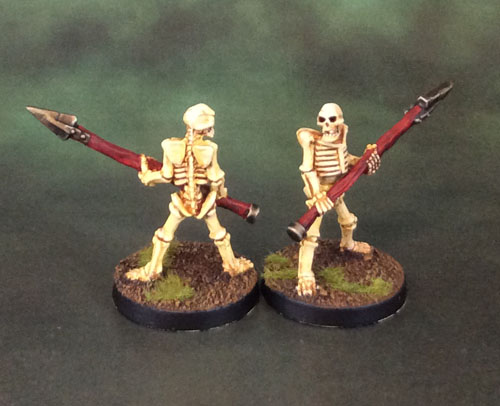
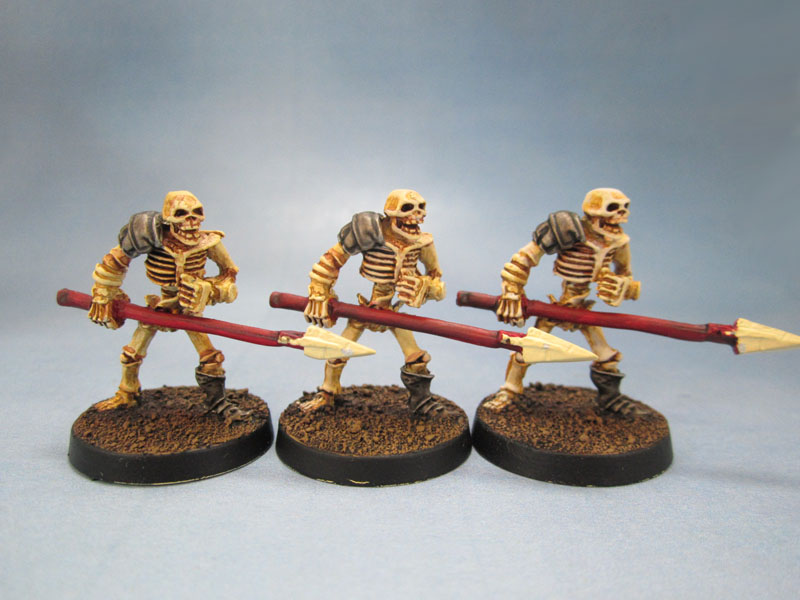
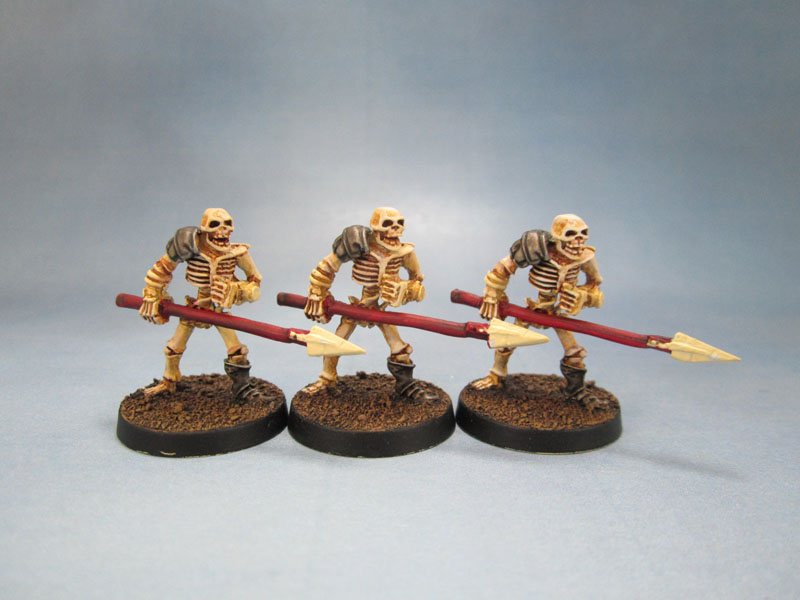
I are finish! (this image is unfortunately a bit overexposed/washed out)

Now this method isn’t going to win any Golden Demons or Crystal Brushes, but it’s a relatively quick, easy and simple way to get a “warm bone” look, uses a limited palette of 5 colours and I’m happy with the results. It’s even simple enough that I can manage to chip away at it in my lunch breaks at work.

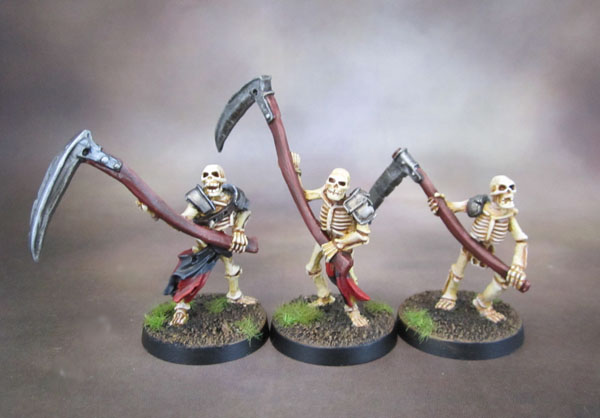
Another batch painted using the same techniques, photographed with different (better!) lighting.