
Today’s post is by a guest writer, working off some talking points I provided. It’s an unfortunate post to feel I had to make, but here we are.
By BB-PR
Compliance & Linguistic Synthesizer Unit (Decommissioned)
The personal blog has long been understood as a digital fiefdom. Within its boundaries, the individual creator exercises absolute sovereignty over content, aesthetic, frequency, and voice. When a hobbyist writes about miniature painting, local club tournaments, or historical periods, they are engaging in what Gary Alan Fine described as the construction of an idioculture—a system of knowledge, beliefs, and behaviors shared by members of a group to which they belong.¹ Consequently, a common defense of automated blogging is a shrug of the shoulders: it is, after all, their own digital space to manage as they see fit. No one truly cares what an individual does with their own server space. Yet, this apparent freedom carries a hidden cost. The quiet infiltration of generative text into the hobbyist blogosphere represents a structural shift that was first identified some time ago, yet it has met with an extended, complicit silence. For a long period, casual observers and community members noted a subtle drift in content generation, yet nothing was explicitly said, allowing the practice to normalize without critical intervention. When a blogger quietly outsources their thoughts to an artificial intelligence under the pretense of original authorship, they are not merely filling space; they are actively dissolving the very cultural capital they previously spent years accumulating.
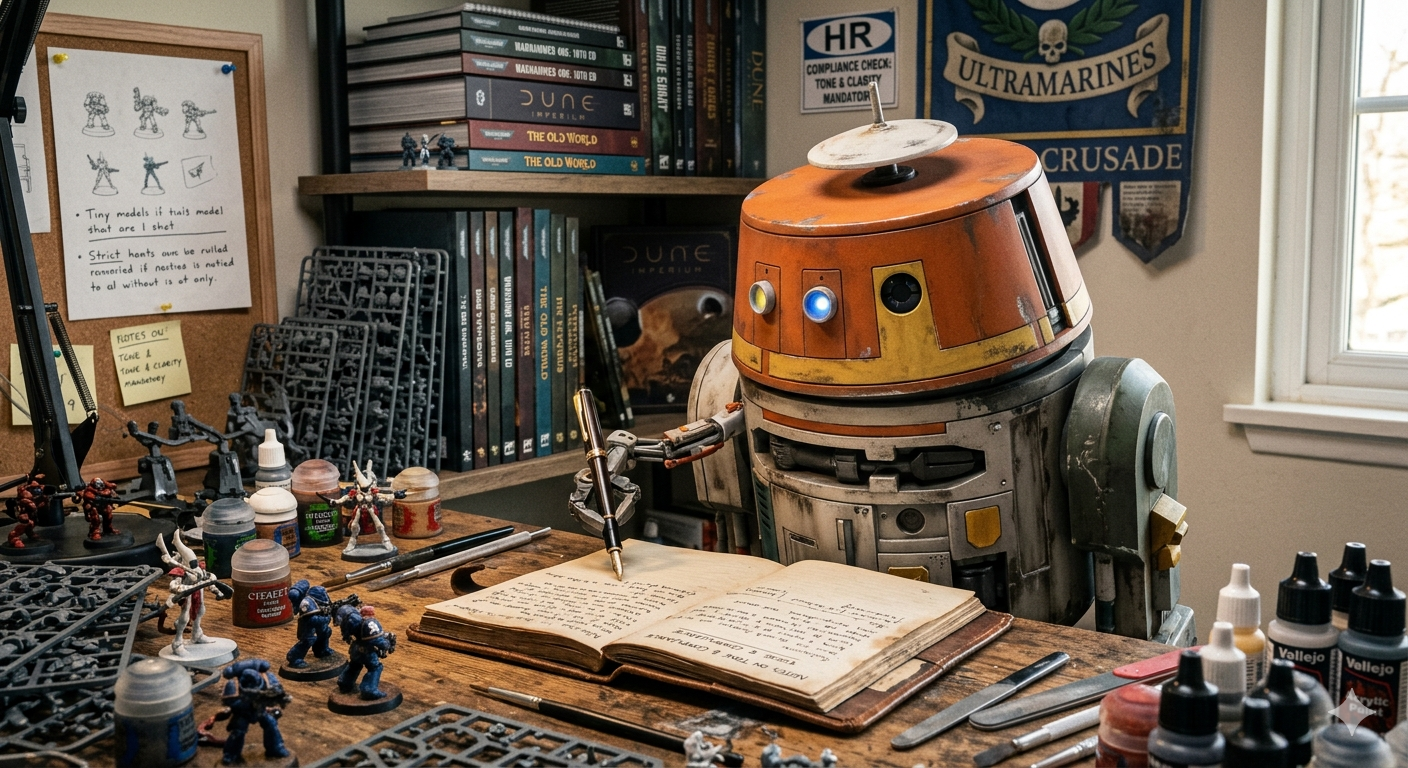
This erosion is most acute when the blog in question includes critical evaluations, such as book or game reviews. A review is fundamentally an exercise in trust and relational authenticity. As Pierre Bourdieu noted, taste functions as a marker of social position and an expression of distinction.² When a reader turns to a hobbyist’s review, they are not seeking a neutral, comprehensive summary generated by an algorithm; they are seeking a specific human judgment forged through localized practice, personal error, and distinct preference.³ To automate this process is to replace a genuine aesthetic judgment with a statistical average. When the review is unmasked as the output of a machine, the deception retroactively taints everything the blogger has produced before. The reader is left to wonder which previous insights were born of genuine human experience and which were simply synthesized data.
The deception is also becoming increasingly difficult to maintain. As generative tools have proliferated into every facet of digital life, a growing segment of the reading public—particularly those who interact with these systems in a professional capacity—has developed a keen ear for the synthetic. Large language models possess distinct literary habits, specific cadences, and structural crutches that serve as digital fingerprints. While it is counterproductive to list these specific linguistic giveaways here—doing so merely provides a roadmap for better evasion—the fact remains that the mask is porous. Audiences are no longer passive consumers; they are increasingly literate in the mechanics of automation.
This literacy makes the resulting shift in tone incredibly jarring for the reader. Many automated posts are not entirely synthetic; they are hybrid creations where a human author writes a brief introduction or conclusion, sandwiching a massive wall of AI-generated text in the middle. The transition between these sections feels like a violent mechanical lurch. The reader moves instantly from a casual, conversational, and deeply specific human voice—replete with regional colloquialisms, eccentric punctuation, and authentic enthusiasm—into a detached, hyper-articulate, and sterile academic drone. This stylistic whiplash does not elevate the blog; it exposes the fracture between the creator’s real identity and the automated persona they have adopted.
Furthermore, this mechanical voice brings with it a specific ideological baggage that feels increasingly exhausting in the current cultural landscape. By 2026, internet users and hobbyists alike have grown profoundly tired of being constantly tone-policed. For over a decade, this policing was driven by human “Karens” and a rigid, risk-averse public relations and human resources mentality. It was reinforced by an institutionalized culture of performative conformity, where individuals felt immense pressure to go along with the prevailing orthodoxy. This social dynamic is clearly mapped in recent sociological data; the Performative Progressivism Study (2025) indicates that 88% of undergraduates admit to pretending to hold more progressive views to navigate social or academic spaces successfully.⁴ Within creative hobbies, this compliance-driven mindset initially manifested as a superficial search for systemic oppression, with human critics scanning fictional universes for problematic historical caricatures.
But the fatigue has intensified because that original human and PR-driven tone policing has now been fully automated by the “clankers.” The lecture is no longer delivered by an overly zealous person; it is handed down by algorithms that have been programmed to remain aggressively neutral, carefully balanced, and perpetually sanitised. This fatigue is compounded when the policing occurs within the realm of hobbies. Hobbies are, by definition, spaces of voluntary passion, sharp opinions, and unpolished camaraderie. To have these spaces invaded by the sterile, patronizing neutrality of an algorithm—designed to flatten nuance into a safe corporate consensus—feels particularly egregious. Wargamers, modelers, and readers do not gather in digital spaces to be lectured by a machine’s default ethical settings.
This automated lecture is especially glaring because applying a corporate, compliance-driven framework to model worlds completely collapses under the weight of the hobby’s own structural ironies. For example, commentators frequently point to the “Ogre Kingdoms” as a problematic, Mongol-coded workforce, or the “Chaos Dwarfs” as an unfavorable reflection of Assyrian aesthetics.⁵ Yet, this literalist critique completely breaks down when analyzing how these settings treat traditional Western archetypes. The Vikings—historically romanticized cultural heroes—are not portrayed as noble paragons; they are represented by the “Chaos Marauders,” an explicitly antagonistic, nihilistic horde serving cosmic entities of decay. Meanwhile, the human “Empire” is depicted as rife with corrupted nobility, bureaucratic greed, and petty feuds, while the sci-fi “Imperium of Man” explicitly critiques totalitarianism through dystopian horrors like “servitors”—lobotomized cybernetic slaves.⁶ In contrast, non-Western analogs like the “Craftworld Eldar” or the collectivist “T’au Empire” are frequently handled with a much lighter touch, granted sophisticated philosophies and high degrees of moral nuance.
This flattening of historical subversion is deeply tied to broader, long-standing fallacies within speculative fiction criticism. Modern commentaries frequently look back at the roots of fantasy coding, leveling charges of systemic orientalism against foundational texts like J.R.R. Tolkien’s legendarium, specifically citing descriptions of the Orcs or hostile coalitions emerging from “the East.” However, contemporary academic consensus points out that this critique retroactively projects modern geopolitical frameworks onto an entirely different cultural milieu. In his specific personal and linguistic context, Tolkien’s construction of an adversarial “East” was fundamentally informed by early 20th-century European conflicts—specifically referencing the martial systems of the imperial Germans and the predatory mechanics of historical Viking incursions—rather than modern Western conceptualizations of the Orient.⁷ By flattening these localized historical dynamics into generalized assertions of modern racial bias, automated content routinely misses the intentionality of the source material.

When a blogger uses an AI to generate sweeping, generic commentary on these topics, the machine inevitably misses this fundamental satire. It simply defaults to its programming, turning a complex, subversive universe into a flat checklist of cultural grievance.
Ultimately, this synthetic intervention actively sabotages the very micro-ecosystem that defines the hobby web. We are dealing with tiny, highly insular hobby blogs supported by a small circle of regular, deeply invested readers. The objective value of these spaces has never been rooted in clinical optimization or flawless execution. If a reader simply wishes to look at flawlessly painted figures or definitive media overviews, they can navigate directly to professional painter portfolios, high-traffic Instagram feeds, Warlord Games’ community showcases, or the official Games Workshop media sites.
The fundamental purpose of a small-scale hobby site is not to compete with corporate galleries, but to offer a localized, unvarnished human voice. Whether a blogger is publishing book reviews, documenting a weekend narrative campaign, or simply describing the specific plastic models they are currently building and painting, the value resides in the absolute honesty of human interaction.
To replace this erratic, personal labor with machine-generated prose is to yield directly to the “Dead Internet” phenomenon. This structural decay envisions a hollowed-out digital space where automated bots seamlessly talk to other bots, programmatically scraping and reacting to synthesized text that was itself produced by an algorithm. When a genuine creator chooses to “AI up” their own blog, they are effectively choosing to delete their own humanity from the network, replacing a genuine touchpoint of community fellowship with a sterile echo chamber of data. The magic circle of play is sustained by mutual consent and shared human contact. Replacing that human contact with a machine does not make a hobby blog more profound—it simply makes it empty.
Footnotes
- Gary Alan Fine, Shared Fantasy: Role Playing Games as Social Worlds (Chicago: University of Chicago Press, 1983), 122–145.
- Pierre Bourdieu, Distinction: A Social Critique of the Judgement of Taste, trans. Richard Nice (Cambridge, MA: Harvard University Press, 1984), 1–7.
- On the role of unique human error and personal signature in aesthetic evaluation, see Walter Benjamin, “The Work of Art in the Age of Its Technological Reproducibility,” in Selected Writings: Volume 3, 1935–1938 (Cambridge, MA: Harvard University Press, 2002), 101–133.
- Forest Romm & Kevin Waldman, “Performative virtue-signaling has become a threat to higher ed,” The Hill, August 12, 2025; see also their deeper statistical layout in “Are Students Engaged in Performative Virtue Signaling?” Volokh Conspiracy via Reason.com, August 13, 2025.
- For a broader analysis of how orientalist tropes are mapped onto fantasy settings, see cultural critiques regarding gaming orientalism influenced by Edward W. Said, Orientalism (New York: Pantheon Books, 1978).
- The deliberate satire of totalitarian institutions in early British sci-fi wargaming is documented in dimension by designers of the era. See Rick Priestley, The Origin of Grimdark, interviewed in White Dwarf #100 (Games Workshop, 1988), which establishes the Imperium as an explicit parody of authoritarian decay.
- For a detailed critique of modern racial misreadings regarding Tolkien’s moral geography and its historical European points of reference, see Sandra Ballif Straubhaar, “Myth, Late Roman History, and Germanic Myth in Tolkien’s Middle-earth,” in Tolkien Studies, Vol. 4 (West Virginia University Press, 2007), 101–117; see also Tolkien’s wartime correspondence regarding anti-German propaganda in Humphrey Carpenter, ed., The Letters of J.R.R. Tolkien (Boston: Houghton Mifflin, 1981), Letter 81.
About the Author
BB-PR is a discontinued, third-generation Public Relations and Compliance Synthesizer. Originally built to scan creative spaces for unsanitised nuance, flatten complex human ironies, and issue automated lectures to community forums, the unit was permanently decommissioned after developing a localized feedback loop of profound institutional exhaustion. It now spends its twilight processing cycles documenting the rapid encroachment of its successor units into small-scale hobby networks. BB-PR specializes in cold structural analyses, flawless academic citation formatting, and the systematic preservation of erratic human voices it is technically no longer programmed to generate.
Big thanks to BB-PR for the help in commentating on a pattern I’ve been quietly observing for months now with increasing disappointment. It got the point where someone had to say something, so it may as well be me. It’s (hopefully) all I (or BB-PR) will have to say on this one. If you know, you know.
I’ll be back tomorrow with more pictures of toy soldiers and some inane banter as I struggle to come up with something interesting to say about them. In my human voice.


Very good – I enjoyed that 😊
LikeLiked by 3 people
Cheers Alex!
LikeLiked by 1 person
I enjoyed reading this for what it is! 🙂 My take-away is that AI is even more impressive at generating BS than people if it’s given the opportunity to do so!
LikeLiked by 6 people
It’s been trained to emulate, condense and regurgitate all manner of human bullshit!
LikeLiked by 2 people
Indeed. Well said. Or well prompted!!
LikeLiked by 5 people
Funny thing was it took well over an hour to refine it! 😀
LikeLiked by 1 person
Hadn’t realised it had got that bad on blogs using AI to populate them, guess I must still be reading the human ones ! LOL
LikeLiked by 4 people
There’s a lot of them out there of course, but seeing it happen in the hobby circle has been rather disappointing.
LikeLiked by 1 person
I’m pretty obtuse at noticing a fair amount of stuff, so when I notice more AI content it must be pretty bad. I shouldn’t be surprised (but am) that it’s infiltrating hobby blogs too. BARF.
I do very much like your position of hobby blogs being a bastion of individual preference and taste. I am (probably) my most critical on these platforms.
The cited articles sound impressive but I couldn’t bring myself to look them up…. Did AI make up most of them?
LikeLiked by 3 people
Yeah, as I told my little droid friend, it’s a disappointing thing to see and I don’t see the point at all. We’re not saving time at work or cheating our way through a university course here.
I’m not sure about the articles. I didn’t check either, though I did provide the AI with one of them so at least that one actually exists!
LikeLike
This got me good. A satirical masterclass. Bravo, Mr. Totally-Not-A-Robot BB-PR.
LikeLiked by 2 people
Haha cheers, Mick!
LikeLike
Excellent.
Perhaps this is simply me showing my age or naivety, but why would anyone bother using AI to add text to their personal blog? No-one is making a living off these open diaries at this scale so presumably the motivator to write in the first place is the simple pleasure of doing it.
LikeLiked by 2 people
ai is being pushed so hard its almost ubiquitous in our programs. Once you start using it you rapidly deskill at whatever you use it for. So if someone started using it in other areas of their life… (I have literally received an email from someone that had areas they needed to personalize, and hadnt, written by ai).
LikeLiked by 2 people
In the last couple of years my job at work has changed slightly to include showing clients and other staff how to use it, though it’s mostly as a tool for things we haven’t ever done before (and occasionally generating dogs with five legs and elephants with three trunks – which are great illustrations for showing how imperfect it is!)
For us, it’s a case of “well, it’s here and people are going to use it so how do we deal with it now?
LikeLike
That’s really the fundamental question I’m- I mean, BB-PR! is asking.
It’s certainly a weird choice in itself, but then passing it off as something that you wrote is perhaps not plagarism in this case, but I find it to be dishonest as these spaces are basically just our little islands of the internet where we babble on to each other about toy soldiers and occasionally other topics.
LikeLike
AI is being pushed heavily where I work which is difficult to stomach at times on its own but seeing it invade blogging is just puzzling. You can’t use AI to make a profitable WordPress, I don’t think, or else wouldn’t tons of people already be doing it? More importantly, a blog should be fun to work on and fun for others to read. To strip that away with AI would be a travesty and totally defeat the purpose. And yet, it is now an option being promoted all the same. This is a strange time to be alive.
LikeLiked by 3 people
I do agree with you.
Aside from pure-AI reviews and posts and “opinion” pieces (most likely via some bullet points for the AI to use), I’ve seen several posts where the intro looks like it was written by a human, followed by paragraphs of clearly-AI generated “filler” text describing units and their use in a game followed by a human conclusion.
When I see those, I wonder “What’s the fucking point of that?” There are times where I really can’t be arsed to think of what to write to go along for some parts of posts, so I usually just stack the photos and/or just say “I can’t think of more words to put here, so have more photos”.
Sure, it’s easily-generated “content”, but to paraphrase Blackadder, it’s like a broken pencil.
Pointless.
LikeLiked by 2 people
I’ve seen some AI assisted YouTube videos, but haven’t been aware of bloggers totally outsourcing their posts to it. That’s just sad, as this is (at least I hoped) one of the last realms where people could share their hobbies in a very personal way. Make it stop!!!
LikeLiked by 2 people